

Who is Covered by OSHA?
OSHA covers most private sector businesses and their workforces in all fifty states, the District of Columbia, and other U.S. jurisdictions – either directly through Federal OSHA or through an OSHA-approved state plan. However, the situation relating to public sector employees is more complicated. In this article, we will discuss:
- Who is covered by OSHA in the private sector?
- Who is not covered by OSHA in the private sector?
- Special arrangements in the private sector
- Who is covered by OSHA in the public sector?
Who is Covered by OSHA in the Private Sector?
OSHA applies to all businesses in the private sector with at least one employee unless the business operates in an industry in which workplace safety and health is regulated by another federal agency such as the Mine Safety and Health Administration, the Department of Energy, or the Coast Guard.
Although required to comply with OSHA’s hazard-specific standards, small businesses with fewer than ten employees and those operating in a low risk industry are partially exempt from OSHA compliance inasmuch as they are not required to maintain and submit injury or illness records.
However, all businesses – including small and low risk businesses – are required to comply with OSHA’s General Duty clause and report any workplace fatality, in-patient hospitalization, amputation, or loss of an eye. Small business owners can find out more in this OSHA handbook.

Get The FREE
OSHA & HIPAA Checklist
Immediate Delivery of Checklist Link To Your Email Address
Please Enter Correct Email Address
Your Privacy Respected
HIPAA Journal Privacy Policy
Who is Not Covered by OSHA in the Private Sector?
In addition to employees who work for a business regulated by another federal agency, volunteers, self-employed workers, and the family members of farm employees are not covered by OSHA in the private sector inasmuch as they do not have the same rights as employees to a safe workplace.
Nonetheless, if a volunteer or self-employed worker works in a workplace that is subject to OSHA’s hazard-specific standards, the standards still apply. Therefore, if a volunteer is tasked with a job that requires the provision of PPE, the business owner must ensure adequate PPE is provided.
Additionally, if a volunteer, a self-employer worker, or a family member of a farm employee is involved in an accident that results in a workplace fatality, in-patient hospitalization, amputation, or loss of an eye, the event has to be reported to OSHA and recorded in the workplace’s injury logs.
Special Arrangements in the Private Sector
Throughout the private sector, there are a number of “special arrangements” that result in exceptions to the usual coverage rules. For example, volunteer firefighters may be covered by OSHA in the private sector if they are remunerated for their services or covered by workers’ comp.
There are also some special arrangements due to federal agencies adopting OSHA standards and applying them to both paid and uncompensated workers – for example, the Environmental Protection Agency’s Hazardous Waste and Emergency Response standard.
Special arrangements also apply to cabin crew when an aircraft is in flight. Although the Federal Aviation Administration regulates aircraft safety and health, cabin crew in the private sector are protected by OSHA standards relating to noise, hazard communication, and bloodborne pathogens.
Who is Covered by OSHA In the Public Sector?
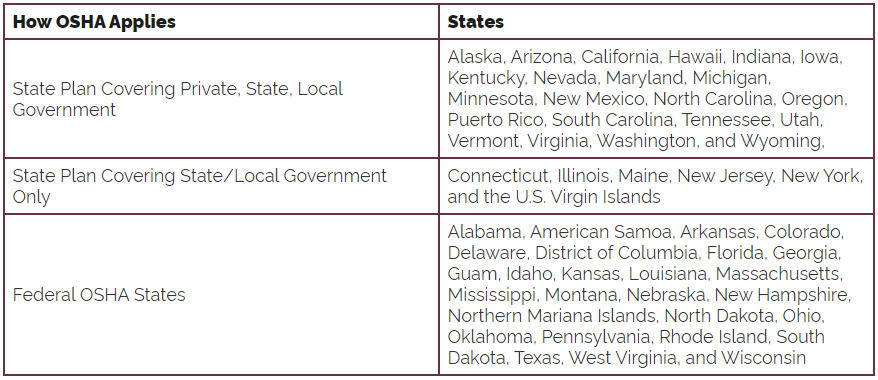
It was mentioned in the introduction that the situation relating to public sector employees is more complicated. This is because OSHA’s protections apply to all federal agencies, but not to state and local government employees unless they work in a state that has a state plan covering public sector employees.
There are currently twenty-two state and territories with state plans that extend the same protections enjoyed by private sector workforces to public sector employees. A further six state plans cover state and local government employees only. In these six locations, federal OSHA applies to the private sector.
Who is Covered by OSHA? Conclusion
It can be important to know who is covered by OSHA and to what extent if a member of your workforce suffers an accident or contracts an illness at work. Employers who are unsure about their OSHA compliance obligations should seek professional compliance advice.




