

Digital Marketing for Doctors
Digital marketing for doctors can be a cost-effective way to generate leads, convert leads to new patients, and retain patients for as long as treatment is required. However, when adopting a digital marketing strategy for doctors, it is important to be aware of federal and state regulations that govern the content and frequency of digital communications.
There is a wide range of “opinions” about how many new patients a doctor needs to acquire per month in order for a medical office to remain sustainable. Many opinions ignore factors such as relationships with Primary Care Physicians and insurance networks, the type of healthcare services provided, and how healthcare services are provided (i.e., remotely). The location of a medical office and health inequalities in that location can also be factors.
Consequently, when an “opinion” advocates a digital marketing strategy for doctors in order to acquire “xx” new patients per month, the opinion often goes overboard on the number of marketing activities required and/or sets unrealistic expectations for the power of digital marketing for doctors. However, while it might be impractical to implement 101 digital marketing activities, there are five proven digital activities doctors can adopt to attract and retain new patients.
5 Proven Digital Marketing Activities for Doctors
The following five digital marketing activities for doctors assume a website already exists. Not all doctors have – or want – a website, but a website is necessary to support most digital marketing activities. Furthermore, 58.5% of the adult U.S. population use the Internet to look for health or medical information according to the National Center for Health Statistics. A medical office that does not have a website is ignoring more than half of its target audience.

Get The FREE
HIPAA Compliance Checklist
Immediate Delivery of Checklist Link To Your Email Address
Please Enter Correct Email Address
Your Privacy Respected
HIPAA Journal Privacy Policy

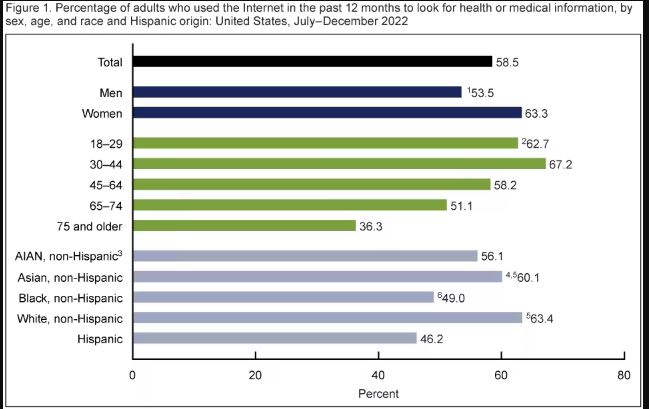
Source: National Center for Health Statistics. National Health Survey 2022.
The website should not only provide information about the healthcare services being provided and the healthcare professional(s) providing them, but the content of the website should also be frequently refreshed via a blog, FAQ section, and/or other healthcare resources. It is also important that the website is designed to be mobile-friendly (i.e., functions on mobile devices). Thereafter, the website can act as the foundation for the following proven digital marketing activities.
Ensure the website is search optimized
A website that is search optimized appears higher in search engine results pages and attracts more visitors. To ensure the website is search optimized, medical offices should publish content written to include long targeted keywords and phrases (i.e., “medical office in Lancaster”) and containing keyword-rich URLs (i.e., www.yourwebsite.com/medical-office-in-lancaster/). Longer keywords and URLs can also increase the Clickthrough Rate (CTR).
“Longer Keywords Tend to Have a Higher Overall CTR”. Source: Backlinko.com
In addition to optimizing content and URLs for location-based text searches, medical offices should also claim and regularly update their free Google Business Profile. Google allows medical offices to post links to their websites, images, news, contact details, opening hours, and more on their Business Profiles. Importantly, Google Business Profiles also appear on Google Maps – allowing potential patients to more easily find an office and plan their route.
Use social media to market website content
Using social media to market new blogs, FAQs, and healthcare resources published on the doctor’s website is a simple way to drive more traffic to the website. This is because, not only might users be searching for the information published on the website, but social media algorithms funnel related content into users’ timelines. Even when some content is not directly relevant to one user, it may still be shared among the user’s network of contacts.
However, in the context of medical marketing for doctors, it is important to distinguish between using social media to market website content and social media marketing. Although social media marketing is advocated by several sources discussing medical marketing for doctors, there are multiple legal, privacy, and data security risks attached to interacting with patients on social media platforms – notwithstanding it may be impossible to verify a social media user’s identity.
Manage online reviews professionally
One of the most important digital marketing activities for doctors is to manage online reviews professionally. It has been claimed that 84% of patients read online reviews before choosing a new healthcare provider and that 51% of patients read at least six reviews before making a final decision. Significantly, 61% of patients would not necessarily be put off by a negative review. It is often more important whether the doctor has responded to the negative review.
“45% of patients noted that, when choosing a provider, they are swayed by whether doctors respond to reviews”. Source: Yahoo! Finance
One of the advantages of claiming a Google Business Profile is that this is where most potential patients look for reviews of a doctor. However, there are multiple other review sites. These – plus comments left on social media platforms – should be monitored for both positive and negative reviews and responded to appropriately. Managing online reviews professionally can help protect a doctor’s reputation and show potential patients the doctor is responsive and caring.
Monitor the effectiveness of digital marketing activities
Monitoring the effectiveness of digital marketing activities is the most accurate way of determining which activities are working. There are numerous tools and content management systems that can help medical offices make their digital marketing strategies for doctors more effective. For example, Google Analytics can provide insights into the performance of website content, while social media analytic tools can report on how often posts are shared.
However, when using activity tracking technologies, it is important to be aware the technologies must be configured not to collect information that could imply a healthcare relationship. If an analytics tool collects information that might qualify as Protected Health Information, doctors must enter into a Business Associate Agreement with the software vendor and any data collected by the software must be stored and transmitted in compliance with HIPAA.
Paid for advertising
With the information gathered from monitoring the effectiveness of digital marketing activities, doctors and medical offices can fine-tune digital activities to target specific services to specific platforms. It may also be viable to revise how content is published to increase its content share rate, or to support activities that are not producing the desired results with paid for advertising in order to elevate selected content to the top of search engine results pages.
“Pay-per-click traffic converts 50% better than organic traffic.” Source: cropink.com
One of the major advantages of PPC for doctors is that advertisers can tailor which ads are displayed to each demographic, but only pay for advertising when an individual clicks on an ad. This can be a useful tactic to develop brand recognition for minimal cost. Pay-per-click advertising can also be configured to retarget individuals who have visited a web page or opened a social media post, but who have not yet interacted with the medical office.
Email and Digital Marketing for Doctors
The primary reason email marketing is not included among the above list of proven digital marketing activities for doctors is HIPAA compliance. The HIPAA marketing rules limit outbound doctor-to-patient marketing communications to only those exempted from the definition of marketing in §164.501 of the HIPAA Privacy Rule. Consequently, a doctor that qualifies as a HIPAA covered entity can only use email marketing:
- To send refill reminders or otherwise communicate about a drug or biologic that is currently being prescribed for the individual,
- For treatment of an individual by a health care provider, including case management or care coordination for the individual,
- To direct or recommend alternative treatments, therapies, health care providers, or settings of care to the individual, or
- To describe a health-related product or service that is a replacement for, or an enhancement to, an existing product or service that is included in – or that adds value to – a plan of benefits.
For these uses of email marketing to be HIPAA compliant, any financial remuneration received by the doctor in exchange for making the communication must be reasonably related to the doctor’s cost of making the communication. Other considerations to take into account with this form of digital marketing for doctors include HHS’ Anti-Kickback Regulations, Stark’s Law, and FTC regulations regarding the content and frequency of marketing communications.
In addition to federal regulatory requirements, many states have adopted more stringent privacy regulations. For example, many states require individuals to affirmatively opt in to receive marketing communications, while New York’s Health Information Privacy Act regulates more information than HIPAA and extends the reach of the Act beyond state boundaries. These measures can have an impact on the effectiveness of outbound digital marketing for doctors.
Why You Should Seek Advice on Digital Marketing for Doctors
A number of online sources advocating Internet marketing for doctors tend to write about digital marketing strategies that work in other industries and apply them to the medical profession without considering HIPAA. While most inbound marketing strategies can be used in a HIPAA compliant manner, doctors should take care when interacting with individuals on social media or when using tracking technologies to monitor the effectiveness of digital marketing activities.
As the content of websites, blogs, FAQs, healthcare resources, and social media posts also has to comply with FDA regulations governing the marketing of dietary supplements, foods, drugs, devices, and other health-related products, healthcare professionals considering Internet marketing for doctors are advised to seek advice from a digital marketing agency with a verifiable track record in managing compliant digital marketing activities for doctors.




