

September 2026 Healthcare Data Breach Report
There was an increase in reported healthcare data breaches in September, which rose 25% month-over-month. Based on current listings on the HHS Office for Civil Rights (OCR) data breach portal, HIPAA-regulated entities reported 65 data breaches in September.
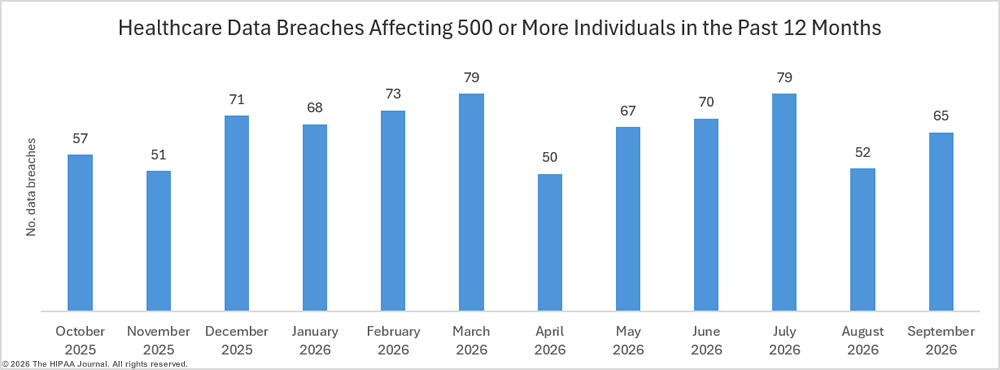
The OCR breach portal lists summaries of breaches of unsecured protected health information (PHI) affecting 500 or more individuals. Over the past 12 months, an average of 65 large healthcare data breaches were reported to OCR each month. Up to and including September 30, 2026, 603 large healthcare data breaches have been reported to OCR. The year-to-September 30 figures show a 4.7% reduction in healthcare data breaches year-over-year, although data breaches are well above the level seen in previous years.
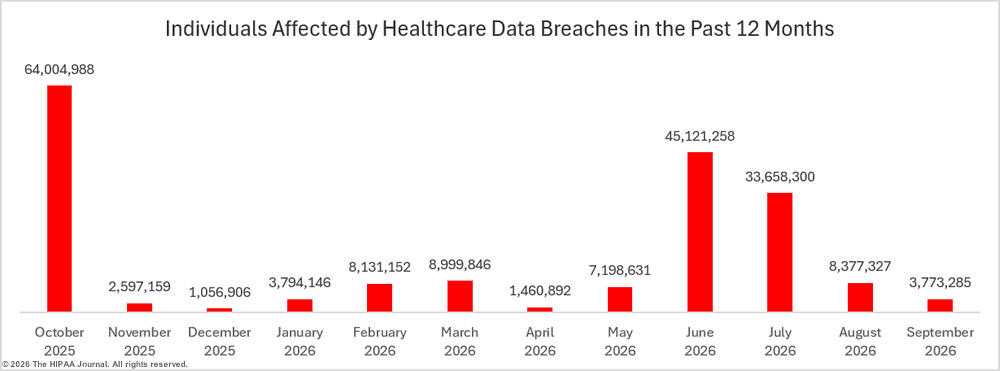
Across the 65 data breaches, the protected health information of 3,773,285 individuals was exposed or impermissibly disclosed – the third-lowest monthly total in the past 12 months, and a 55% reduction in affected individuals from August. September’s figures are likely to increase, as 10 data breaches were reported to OCR using estimated totals of 500 or 501 affected individuals, as data breach investigations had not been concluded at the time of notifying OCR. Currently, September’s total is 75.9% lower than the 12-month average of 15.7 million affected individuals each month.
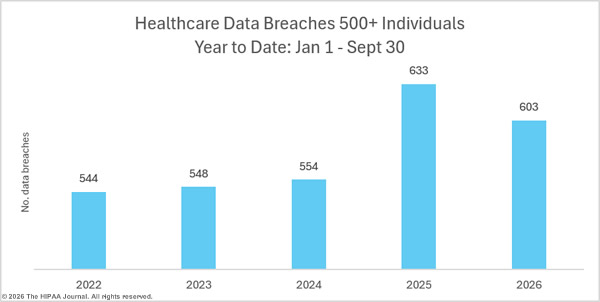
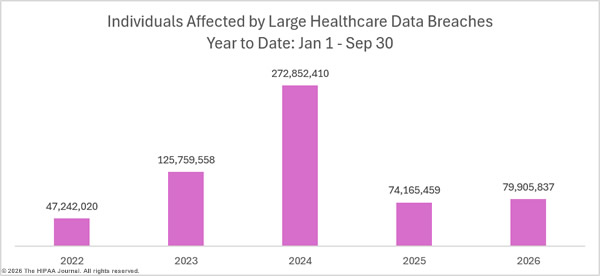
The year-to-September 30 figures provide a clearer picture of the severity of healthcare data breaches this year. While the current figures show a slight fall in reported data breaches, there has been a 7.7% year-over-year increase in the number of affected individuals.
Your privacy respected – Read our privacy policy

Your privacy respected – Read our privacy policy
The Biggest Healthcare Data Breaches in September 2026
In September, 23 data breaches were reported as affecting 10,000 or more individuals, including 9 breaches affecting 100,000 or more individuals. All but one of the 23 data breaches were due to hacking. The largest data breach of the month was a week-long hacking-related network compromise at the school Medicaid billing service provider, Paradigm Healthcare Services, which involved the PHI of 970,403 Medi-Cal members. The telemedicine provider Call-on-Doc reported a hacking incident involving a 12-day network compromise over the Christmas and New Year period in 2025. The threat actor exfiltrated files containing the PHI of 648,535 individuals. The third largest data incident of the month occurred at the District of Columbia Department of Health Care Finance and involved the online exposure of two reports containing the PHI of 399,086 Medicaid and DC Healthcare Alliance beneficiaries.
| Rank | Regulated Entity | State | Covered Entity Type | Individuals Affected | Type of Breach |
| 1 | Paradigm Healthcare Services | CA | Business Associate | 970,403 | Hacking incident |
| 2 | Call-on-Doc, Inc. | TX | Healthcare Provider | 648,535 | Hacking incident |
| 3 | District of Columbia, Department of Health Care Finance | MD | Health Plan | 399,086 | Reports containing PHI exposed online |
| 4 | Saber Healthcare Group | OH | Business Associate | 282,727 | Hacking incident |
| 5 | Ridgeway Pharmacy, Ltd | MT | Healthcare Provider | 258,920 | Unauthorized access to PHI on a third-party designed and maintained website |
| 6 | Tarter Krinsky & Drogin LLP | NY | Business Associate | 196,645 | Hacking incident |
| 7 | Atlantic Digestive Specialists, PLLC | NH | Healthcare Provider | 173,853 | Hacking incident |
| 8 | Clover Health | MN | Health Plan | 138,677 | Social engineering incident involving three compromised email accounts |
| 9 | AngMar Management Services | TX | Business Associate | 126,196 | Ransomware attack – Interlock ransomware group |
| 10 | Ultramobile Imaging | NY | Healthcare Provider | 75,000 | Hacking incident |
| 11 | Lexington Hospital Corporation | TN | Healthcare Provider | 67,000 | Hacking incident at the healthcare technology company Aesto Health |
| 12 | Leggett & Platt, Incorporated Employee Benefit Plan | MO | Health Plan | 61,702 | Hacking incident at its third-party pharmacy benefits manager, MedImpact Healthcare Systems |
| 13 | Paylogix LLC | NY | Business Associate | 41,739 | Ransomware attack – Akira ransomware group |
| 14 | Three Oaks Hospice, Incorporated | TX | Business Associate | 36,622 | Compromised email accounts |
| 15 | Universal Dermatology & Vein Care | FL | Healthcare Provider | 35,295 | Hacking incident involving third-party vendor |
| 16 | Trinity Health | MI | Business Associate | 33,234 | Hacking incident involving a business associate |
| 17 | WindRose Health Network | IN | Healthcare Provider | 33,158 | Hacking incident |
| 18 | Provident Behavioral Health | IL | Healthcare Provider | 25,086 | Hacking incident |
| 19 | Comprehensive Orthopedics & Musculoskeletal Care, LLC | CT | Healthcare Provider | 21,897 | Hacking incident |
| 20 | Oculus Pathology | TX | Healthcare Provider | 20,040 | Compromised email accounts |
| 21 | Vernon & Waldrep OB-Gyn Associates | TX | Healthcare Provider | 17,435 | Hacking incident |
| 22 | Applied Healthcare Nursing Division, Inc. d/b/a Doctor’s Choice Home Care | TX | Healthcare Provider | 14,333 | Hacking incident at its EHR vendor (WellSky) |
| 23 | Young C. Park DDS., PC d/b/a Park Dental | VA | Healthcare Provider | 12,400 | Hacking incident |
In September, 10 data breaches were reported by HIPAA-regulated entities as affecting either 500 or 501 individuals. These totals are often used when the investigations into the data breaches have not concluded by the time the breach must be reported to OCR. The totals are then updated when the number of affected individuals is known. These data breaches could turn out to be substantially larger than the initial breach report suggests.
| Regulated Entity | State | Covered Entity Type | Individuals Affected | Type of Breach |
| Health Prime International | IL | Business Associate | 501 | Hacking/IT Incident |
| EZaccessMD, LLC | NY | Business Associate | 501 | Hacking/IT Incident |
| Bacon County Health Services, Inc. | GA | Healthcare Provider | 501 | Hacking/IT Incident |
| Klickitat Public Hospital District #2 – dba Skyline Hospital | WA | Healthcare Provider | 501 | Hacking/IT Incident |
| Camden-on-Gauley Medical Center | WV | Healthcare Provider | 501 | Hacking/IT Incident |
| Next Level Medical, LLC | TX | Healthcare Provider | 501 | Hacking/IT Incident |
| Beaver County Behavioral Health | PA | Healthcare Provider | 501 | Hacking/IT Incident |
| COMHAR, Inc. | PA | Healthcare Provider | 501 | Hacking/IT Incident |
| Craneware, Inc. | FL | Business Associate | 501 | Hacking/IT Incident |
| LHC Group, Inc. | LA | Healthcare Provider | 500 | Hacking/IT Incident |
Causes of September 2026 Healthcare Data Breaches
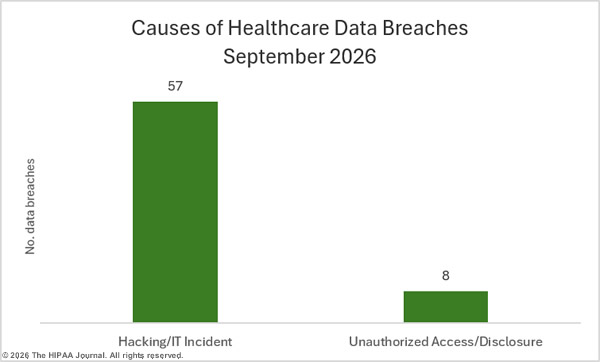
In September, the majority of healthcare data breaches were due to hacking and other IT incidents, which accounted for 87.7% of the month’s data breaches – 57 incidents – with hacking by far the most common data breach cause. Across those 57 incidents, the PHI of 3,367,091 individuals was exposed or stolen, which is 94.9% of all affected individuals in September. The average breach size was 59,072 individuals, and the median breach size was 3,735 individuals.
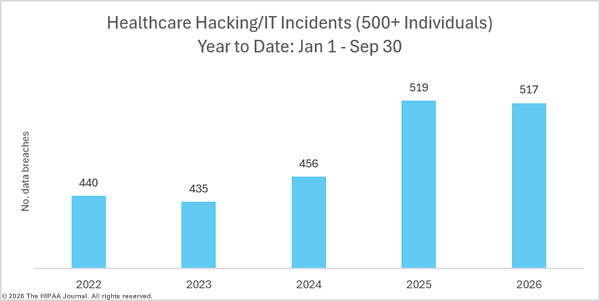
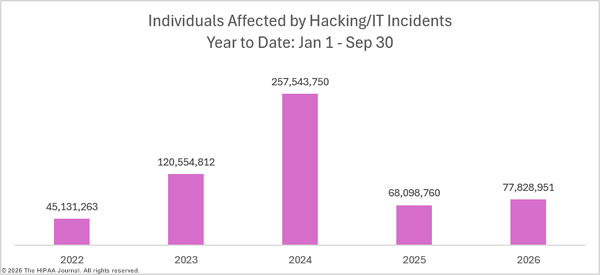
While the year-to-date figures show a small decrease in large healthcare data breaches, hacking/IT incidents are virtually unchanged year-over-year, with only a difference of two data breaches (-0.4%) compared to last year, although the number of individuals affected by these incidents is up 14.3% year-over-year.
The remaining 8 data breaches were unauthorized access/disclosure incidents – 12.3% of the month’s total. Across those incidents, the protected health information of 406,194 individuals was impermissibly accessed or disclosed. The average breach size was 50,774 individuals, and the median breach size was 973 individuals.
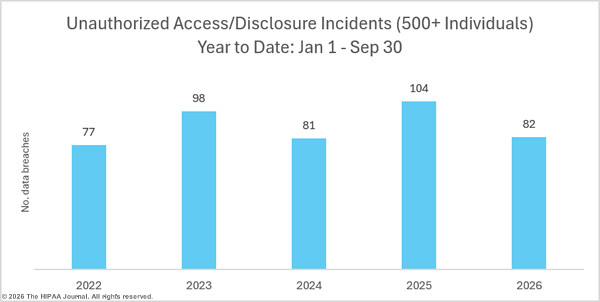
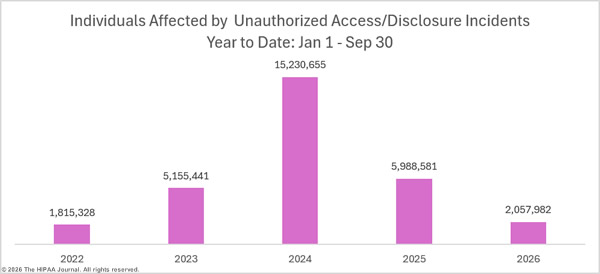
Unauthorized access/disclosure incidents are down 21% year-over-year, and the number of individuals affected by this type of breach is down by 65.6%.
No loss, theft, or improper disposal incidents were reported by HIPAA-regulated entities in September. These incidents are now rare, with only two loss/theft incidents and two improper disposal incidents reported so far this year. These incidents account for just 0.67% of all large healthcare data breaches, and across the four incidents, only 19,000 individuals were affected.
Location of Breached Protected Health Information
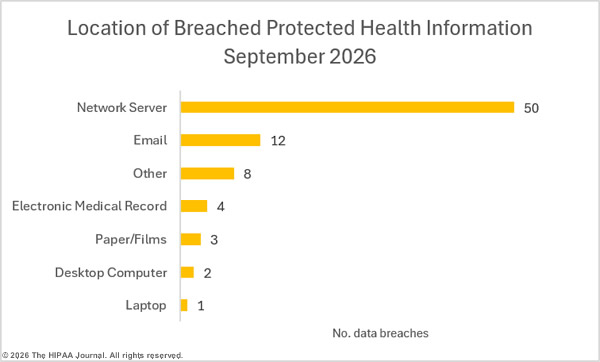
Hacking and other IT incidents accounted for the vast majority of data breaches in September, and these incidents most commonly involve PHI stored on network servers. Email was the second most common location of breached PHI, typically due to phishing incidents and unauthorized access using compromised credentials.
Data Breaches at HIPAA Regulated Entities
The HIPAA Breach Notification Rule requires HIPAA-covered entities to report data breaches to OCR and notify the affected individuals. When there is a data breach at a business associate of a HIPAA-covered entity, the business associate must notify each affected covered entity. The affected covered entities must ensure compliance with the requirements of the HIPAA Breach Notification Rule but may delegate reporting to their business associate.
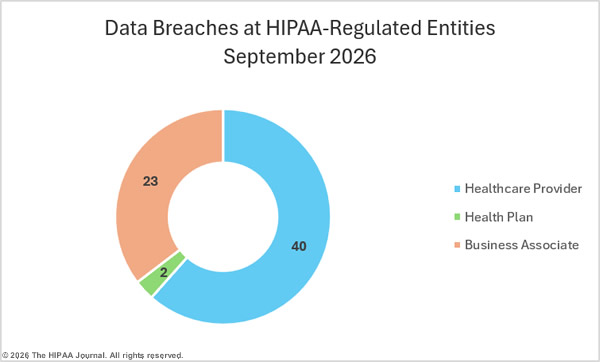
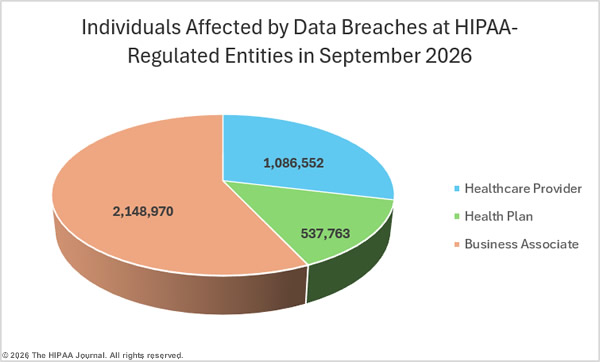
It is common for some covered entities to report data breaches themselves, even though the incident occurred at a business associate. In September, data breaches were reported by 46 healthcare providers, 8 health plans, and 11 business associates; however, 12 of the breaches at HIPAA-covered entities occurred at or involved business associates. The pie charts below are based on where data breaches occurred rather than the reporting entity.
Geographical Distribution of Healthcare Data Breaches
In September, large healthcare data breaches were reported by HIPAA-regulated entities in 29 U.S. states. For the second consecutive month, Texas was the worst-affected state, with 8 large data breaches reported by HIPAA-regulated entities in the state. New York took second place, with 6 reported data breaches, with California, Florida, and Indiana in joint third place with 4 data breaches in each state.
| State | Breaches |
| Texas | 8 |
| New York | 6 |
| California, Florida & Indiana | 4 |
| Georgia, Missouri, New Hampshire & Pennsylvania | 3 |
| Illinois, Iowa, Michigan, Minnesota, North Carolina, Ohio & Washington | 2 |
| Alabama, Alaska, Colorado, Connecticut, Kansas, Louisiana, Maryland, Montana, New Jersey, Oklahoma, Tennessee, Virginia & West Virginia | 1 |
California topped the list in terms of affected individuals, closely followed by Texas. While only one data breach was reported by a HIPAA-regulated entity in Maryland, it was large enough to see the state take third place.
| State | Affected Individuals |
| California | 979,235 |
| Texas | 866,942 |
| Maryland | 399,086 |
| New York | 322,843 |
| Ohio | 287,264 |
| Montana | 258,920 |
| New Hampshire | 175,967 |
| Minnesota | 142,063 |
| Missouri | 68,700 |
| Tennessee | 67,000 |
| Florida | 42,540 |
| Indiana | 37,584 |
| Michigan | 34,060 |
| Illinois | 25,587 |
| Connecticut | 21,897 |
| Virginia | 12,400 |
| Alaska | 9,319 |
| Iowa | 3,996 |
| Colorado | 3,735 |
| North Carolina | 3,080 |
| Georgia | 2,675 |
| Pennsylvania | 2,466 |
| Kansas | 1,240 |
| Washington | 1,117 |
| New Jersey | 1,091 |
| Oklahoma | 854 |
| Alabama | 623 |
| West Virginia | 501 |
| Louisiana | 500 |
HIPAA Enforcement Activity in September 2026
OCR, the primary enforcer of HIPAA compliance, announced one enforcement action in September. A settlement was agreed with Ambry Genetics Corporation to resolve alleged noncompliance with multiple provisions of the HIPAA Security Rule. Ambry Genetics Corporation, a clinical genetic testing and genomics company, reported a breach of the unsecured protected health information (ePHI) of 225,370 individuals to OCR in March 2020. A malicious actor gained access to an email account after an employee responded to a phishing email. The exposed information included names, addresses, dates of birth, driver’s license numbers, diagnosis/condition information, medications, treatment information, and Social Security numbers.
OCR’s investigation determined that Ambry Genetics failed to conduct an accurate and thorough risk analysis to identify risks and vulnerabilities to ePHI, failed to implement policies and procedures for terminating access to ePHI after employment was terminated or access was no longer required, and unique usernames had not been assigned to all employees to allow their interactions with ePHI to be tracked. The alleged HIPAA violations were resolved with a $700,000 financial penalty and a corrective action plan to address the noncompliance issues.
State attorneys general also have the authority to investigate HIPAA-regulated entities and impose financial penalties for HIPAA violations. State attorneys general often join forces to investigate potential HIPAA violations, as was the case with the single penalty announced in September. A coalition of 44 attorneys general participated in a joint action against LabCorp, a North Carolina-based life sciences and healthcare company that provides clinical laboratory diagnostics and drug development services.
LabCorp experienced a data breach at its debt collection company, American Medical Collection Agency (AMCA), in March 2019. Hackers had access to the AMCA network for 8 months and exfiltrated sensitive data including names, personal information, Social Security numbers, financial information, medical test information, and diagnostic codes. The data breach included the ePHI of 10,251,784 LabCorp patients. The multistate investigation determined that LabCorp had violated multiple provisions of the HIPAA Security Rule and state consumer protection and breach notification laws. The case was settled with a $2,287,455 financial penalty, divided between the 44 participating states.
About this Report
The HIPAA Journal’s monthly data breach reports are based on data obtained from the HHS Office for Civil Rights. The data breaches included in this report were reported to OCR in September 2026 but occurred weeks or months previously. The data was obtained from OCR on November 24, 2026. The figures in this report may increase or decrease as HIPAA-regulated entities complete their breach investigations, and those changes will be reflected on our healthcare data breach statistics page and in our annual HIPAA data breach reports. Further information about HIPAA enforcement actions can be found on our HIPAA violations cases page.