Steve Alder


Phishing Attack Impacts 14,305 Patients of Main Line Endoscopy Centers
Main Line Endoscopy Centers, a network of outpatient endoscopy facilities in the Malvern, Bala Cynwyd, and Media regions of Pennsylvania, has discovered an unauthorized individual has gained access to the email account of one of its employees following a response to a phishing email. It is not clear exactly when the account was breached, but it was discovered by Main Line on January 30, 2019. A leading computer forensics firm was retained to assist with the investigation and determine which, if any, emails in the account had been opened and whether any patient information had been compromised. The investigation confirmed that the attackers potentially gained access to the protected health information of certain patients, which included names, dates of birth, and limited clinical information. Some patients also had their Social Security number, driver’s license number, and/or health insurance information exposed. All patients affected by the breach were sent breach notification letters on March 29, 2019 and individuals whose Social Security number or driver’s license number were...
Study Reveals Health Information the Least Likely Data Type to be Encrypted
Health information is the least likely data type to be encrypted, according to the Global Encryption Trends Study conducted by the Ponemon Institute on behalf of cryptographic solution provider nCipher. The study was conducted on 5,856 people across several industry sectors in 14 countries, including the United States. The aim of the study was to investigate data encryption trends, the types of data most likely to be encrypted, how extensively encryption has been adopted to improve security, and the challenges faced by companies when encrypting data. The study shows the use of encryption has steadily increased over the past four years. 45% of surveyed organizations said they have an overall encryption plan or strategy that is applied across the whole organization. 42% said they have a limited encryption plan or strategy, with encryption only used on certain applications and data types. 13% of respondents said they do not use encryption at all on any type of data. The use of encryption varies considerably from country to country. Germany leads the world with the highest prevalence...
Michigan Practice Forced to Close Following Ransomware Attack
A ransomware attack can prove costly to resolve. That cost was not deemed worth it by one Michigan practice, which has now permanently closed its doors. The ransomware encrypted the system at Brookside ENT and Hearing Center in Battle Creek which housed patient records, appointment schedules, and payment information rendering the data inaccessible. The attackers claimed to be able to provide a key to unlock the encryption, but in order to obtain the key to decrypt files, a payment of $6,500 was required. The two owners of the practice, William Scalf, MD and John Bizon, MD, decided not to pay the ransom as there was no guarantee that a valid key would be supplied and, after paying, the attackers could simply demand another payment. Since no payment was made, the attackers deleted all files on the system ensuring no information could be recovered. The partners decided to take early retirement rather than having to rebuild their practice from scratch. The FBI was alerted to the security incident and explained that this appeared to be an isolated attack. No patient data appeared to...

Amazon Launches New System for De-identifying Medical Images
Amazon has announced that it has developed a new system that allows identifying protected health information contained in medical images to be automatically removed to prevent patients from being identified from the images. Medical images often have patients’ protected health information stored as text within the image, including the patient’s name, date of birth, age, and other metrics. Prior to the images being used for research, authorization must be obtained from the patient or all identifying data must be permanently removed. Removing PHI from images requires a manual check and alteration of the image to redact the PHI and that can be an expensive and time-consuming process, especially when large number of images must be de-identified. The new system uses Amazon’s Rekognition machine-learning service, which can detect and extract text from images. The text is then fed through Amazon Comprehend Medical to identify any PHI. In combination with Python code it is possible to quickly redact any PHI in the images. The system works on PNG, JPEG, and DICOM images. A confidence score...
Lawsuit Alleges Sharp Grossmont Hospital Secretly Recorded Patients Having Gynecology Operations
A lawsuit has been filed against Sharp HealthCare and Sharp Grossmont Hospital which alleges the hospital secretly recorded video footage of female patients undressing and having gynaecological examinations performed. According to the lawsuit, the hospital installed video cameras in three operating rooms as part of an internal investigation into the theft of the anaesthesia drug, propofol, from drug carts. The cameras were actively recording between July 17, 2012 and June 30, 2013 at its facility on Grossmont Center Drive in El Cajon, San Diego. During the time that the cameras were recording 1,800 patients were filmed undergoing procedures such as hysterectomies, Caesarean births, dilation and curettage for miscarriages, and other surgical procedures. The motion-activated cameras had been installed on drug carts and continued to record even after motion had stopped. A spokesperson for Sharp Grossmont Hospital confirmed that three cameras had been installed to ensure patient safety by determining the cause of missing drugs from the carts. The lawsuit states that, “At times,...

Get The FREE
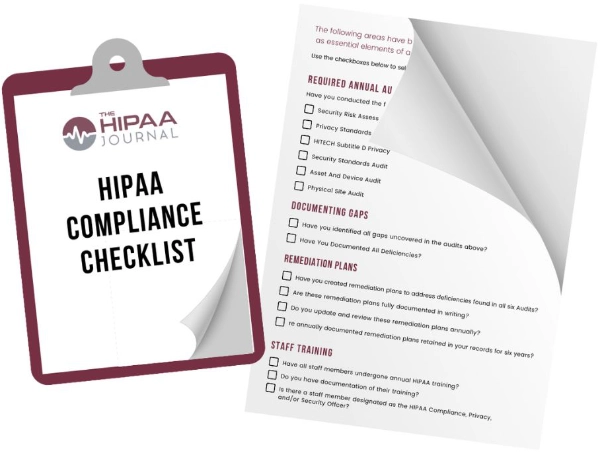
HIPAA Compliance Checklist
Immediate Delivery of Checklist Link To Your Email Address
Please Enter Correct Email Address
Your Privacy Respected
HIPAA Journal Privacy Policy
Get The FREE
HIPAA Compliance Checklist
Immediate Delivery of Checklist Link To Your Email Address
Please Enter Correct Email Address
Your Privacy Respected
HIPAA Journal Privacy Policy