

Steve Alder


12-Month Suspension for Nurse Who Provided Patient Information to New Employer
The New York State Education Department has suspended the license of a nurse practitioner for violating the privacy of patients by providing their contact information to her new employer. In April 2015, Martha C. Smith-Lightfoot took a spreadsheet containing the personally identifiable information of approximately 3,000 patients of University of Rochester Medical Center (URMC) and gave that information to her new employer, Greater Rochester Neurology. The privacy violation was uncovered when several patients complained to URMC about being contacted by Greater Rochester Neurology about switching providers. Prior to leaving URMC, Smith-Lightfoot requested information on patients she has treated in order to ensure continuity of care. URMC provider her with a spreadsheet that contained names, addresses, dates of birth, and diagnoses. URMC did not authorize Smith-Lightfoot to take the spreadsheet with her when she left employment. The provision of the patient list to Greater Rochester Neurology was an impermissible disclosure of PHI and a violation of the HIPAA Privacy Rule. When it...
Impostor, Burglar, and Hackers Obtain PHI of Patients
A round up of healthcare data security incidents reported in the past few days that have resulted in the protected health information of patients being obtained by unauthorized individuals. Blue Cross Blue Shield of Illinois Discovers PHI was Provided to an Imposter Blue Cross Blue Shield of Illinois has discovered the protected health information of some plan members has been disclosed to a doctor who was impersonating another physician. The doctor was employed by its business associate Dane Street and conducted peer to peer reviews for the firm – Further reviews when requests for services have been denied by an insurance company. Dane Street was notified by law enforcement on April 9, 2018 that the doctor had been fraudulently impersonating another physician in order to perform peer to peer reviews. Those reviews required the doctor to view information such as names, addresses, dates of birth, phone numbers, medical service information, and Social Security numbers. Since Social Security numbers were disclosed, affected patients have been offered complimentary credit...
Healthcare Employees Accused of Taking PHI to New Employers
Two HIPAA-covered entities are notifying patients that former employees have accessed databases and stolen protected health information to take to new employers. Former Hair Free Forever Employee Contacts Patients to Solicit Customers Hair Free Forever, a Ventura, CA-based provider of permanent hair removal treatments, has announced that a former employee has stolen patient information and has been contacting its patients in an attempt to solicit customers. The company uses Thermolysis to permanently remove hair. Since the technique is classed as a medical procedure, Hair Free Forever and its employees are required to comply with HIPAA Rules. In a data breach notice provided to the California attorney general, Hair Free Forever’s Cheryl Conway informs patients that the former employee accessed patient files and the company’s database and stole patients’ protected health information, in clear violation of HIPAA Rules. The data theft came to light when complaints were received from customers who had been contacted and told about the former employee’s new practice. An investigation...
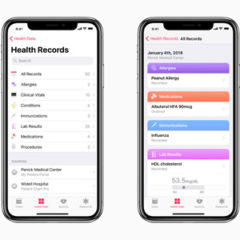
Apple Launches API for Developers to Allow EHR Data to be Used in Care Management Apps
Apple has launched a new application programming interface (API) for developers that will allow them to create health apps that incorporate patients’ EHR data. Patients who load their EHR data into the Apple Health Records app will be able to pass the information directly to third party apps. The move allows app developers to create a wide range of apps that can help patients manage their care. The first apps that will be allowed to access EHR data, if permitted by the patient, should be available in the fall to coincide with the release of iOS 12. One such app that can be used in connection with EHR data through the Apple Health Records app is Medisafe. The Medisafe app will allow patients of participating health systems to download their prescriptions lists and set reminders when their medications need to be taken. The app will also alert them to any potentially harmful interactions between their medications. Apple suggests apps could be developed to help patients manage their medical conditions. Access to EHR data will allow those apps to provide more accurate and useful...
Advisory Issued About Vulnerabilities in Phillips IntelliVue Patient and Avalon Fetal Monitors
The Department of Homeland Security’s Industrial Control Systems Cyber Emergency Response Team (ICS-CERT) has issued an advisory over vulnerabilities affecting certain Phillips IntelliVue Patient and Avalon Fetal monitors. Three vulnerabilities have been identified by Phillips and communicated to ICS-CERT: Two have been rated high and one medium. If successfully exploited, an attacker could read/write memory and introduce a denial of service through a system restart. Exploitation of the flaws could cause a delay in the diagnosis and treatment of patients. Products Affected: IntelliVue Patient Monitors MP Series (includingMP2/X2/MP30/MP50/MP70/NP90/MX700/800) Rev B-M; IntelliVue Patient Monitors MX (MX400-550) Rev J-M and (X3/MX100 for Rev M only); Avalon Fetal/Maternal Monitors FM20/FM30/FM40/FM50 with software Revisions F.0, G.0 and J.3 Vulnerabilities: CWE-0287 – Improper Authentication Vulnerability After gaining LAN access, an unauthenticated individual could exploit the vulnerability to gain access to the memory (write-what-where) on a chosen device within the same subnet....

Get The FREE
HIPAA Compliance Checklist
Immediate Delivery of Checklist Link To Your Email Address
Please Enter Correct Email Address
Your Privacy Respected
HIPAA Journal Privacy Policy
Get The FREE
HIPAA Compliance Checklist
Immediate Delivery of Checklist Link To Your Email Address
Please Enter Correct Email Address
Your Privacy Respected
HIPAA Journal Privacy Policy




