

Steve Alder


Eligible Hospitals Must Now Use QNet for Meaningful Use Attestation
The Centers for Medicare & Medicaid Services (CMS) has recently issued a reminder that eligible hospitals and Critical Access Hospitals (CAHs) participating in Electronic Health Record Incentive Schemes must use the QualityNet Secure Portal (QNet) to submit Meaningful Use attestations in 2018. Back in October, CMS announced it was transitioning Meaningful Use attestations to QNet. Previously two separate systems had been used for attestations and reporting clinical quality measures; but, in order to simplify reporting requirements and streamline data submissions, the QNet portal would be used for both from January 2nd 2018. From October, eligible hospitals and CAHs new to QNet had the opportunity to enroll on the system and get used to how it worked, while existing QNet users were advised to add an MU role to their accounts. From the beginning of this month, the QNet system opened for attestations relating to the 2017 calendar year. The attestation period closes on February 28th. Different Processes for Medicare and Medicaid Hospitals Although attempting to simplify the...
KLAS Rates QliqSOFT ‘Top Performing Vendor’ in its 2017 Secure Communications Report
The Healthcare IT data and insights company KLAS Research has released the 2017 KLAS Secure Communications Report. The report examines current levels of adoption of secure communications platforms in the healthcare industry together with how those solutions are performing in a clinical setting. KLAS Reports are relied upon by healthcare organizations to provide in-depth information on the best IT solutions on the market, saving providers valuable time when searching for a suitable IT solution to meet their needs. To create its reports, KLAS Research analysts interview healthcare providers and gather feedback on the performance of software solutions, how easy they are to implement and use, the level of service and support offered by solution providers, and what healthcare providers think of the solutions. KLAS also identifies the market leaders and solution providers that have gone the extra mile and have incorporated a comprehensive range of features into their software solutions to better serve the healthcare industry. The 2017 KLAS Secure Communications Report covers 15 top...
New Bill Proposes to Amend Iowa Breach Notification Act
A new bill introduced by Iowa Attorney General Tom Miller will, if implemented, extend the definition of a data breach to include medical information, health insurance information and personal information that previously had to be combined with other individual identifiers before a breach was classified as a breach. Since 2014, data breaches affecting more than five hundred Iowa residents have had to be reported to the director of the consumer protection division of the office of the Iowa Attorney General. More than 120 breaches have been notified in the past four years including those at Anthem Blue Cross, Banner Health and Medical Informatics Engineering. The relatively low number of reported breaches implies that either the personal data of Iowa residents is remarkably secure, or that hacked entities are failing to notify the Attorney General´s office as required. AG Tom Miller intends to find out which by introducing an amendment to the state´s current Breach Notification Act that extends the definition of a data breach. Medical and Health Insurance Information to be Included...
92% of U.S. Companies “Vulnerable” to Data Threats
A survey conducted on behalf of global data security company Thales by 451 Research has revealed that 92% of U.S. companies are “vulnerable” to data threats, yet only 86% of respondents plan to increase IT spending in 2018. The annual survey asked more than 1,200 senior security executives about their cybersecurity spending priorities over the coming year. The results of the survey formed the backbone of the Thales 2018 Data Threat Report, in which it was revealed that 46% of U.S. respondents had experienced a data breach in the previous twelve months (up from 24% in the 2017 report). Possibly due to their recent experiences, 92% of U.S. respondents said they were vulnerable to data threats. 53% of the U.S. companies surveyed said they were either “very vulnerable” or “extremely vulnerable” – an increase from 29% in the 2017 report – with more than half or respondents citing “privileged users” as the biggest threat to data security. However, whereas “securing data at rest” was considered to be the most effective defense against data breaches, only 44% of U.S. companies...
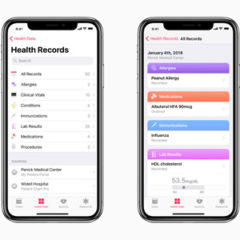
iPhone Users Can View Their Health Records Through the Apple Health App
Patients are being encouraged to obtain copies of their health records and to take a more active role in their own healthcare. Many hospitals are now providing patients with access to some of their health records through patient portals. Apple has now taken ease of access one step further. The company’s Health app has been updated to include a section that allows users to view their medical records directly on their iPhones. The health app will show allergies, test results, diagnoses, procedures, immunizations, and medications and other health information that is typically available through patient portals. When new information is added to patients’ records, they will receive a notification from the app. The Health app is available with iOS 11.3, and is based on Fast Healthcare Interoperability Resources (FHIR) – a standard for transferring and sharing electronic medical records. Data transmitted to the user’s iPhone is encrypted to prevent unauthorized access, and the app is protected by the user’s iPhone passcode to keep the records confidential. Participating hospitals and...

Get The FREE
HIPAA Compliance Checklist
Immediate Delivery of Checklist Link To Your Email Address
Please Enter Correct Email Address
Your Privacy Respected
HIPAA Journal Privacy Policy
Get The FREE
HIPAA Compliance Checklist
Immediate Delivery of Checklist Link To Your Email Address
Please Enter Correct Email Address
Your Privacy Respected
HIPAA Journal Privacy Policy




