

Steve Alder



Delayed Breach Notification Sees CoPilot Fined $130,000 by NY AG
A data breach that occurred in October 2015 should have seen affected individuals notified within 2 months, yet it took CoPilot Provider Support Services Inc., until January 2017 to issue breach notifications. An administration website maintained by CoPilot was accessed by an unauthorized individual on October 26, 2015. That individual also downloaded the data of 221,178 individuals. The stolen data included names, dates of birth, phone numbers, addresses, and medical insurance details. The individual suspected of accessing the website and downloading data was a former employee. CoPilot contacted the FBI in February 2016 to receive help with the breach investigation and establish the identity of the unauthorized individual. However, notifications were not sent by CoPilot until January 18, 2017. CoPilot says the delay was due to the time taken for the FBI to investigate the breach; however, since CoPilot was aware that reimbursement-related records had been stolen, notifications should have been sent sooner. Further, law enforcement did not instruct CoPilot to delay the issuing of...
OCR’s Wall of Shame Under Review by HHS
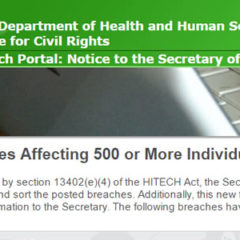
Since 2009, the Department of Health and Human Services’ Office for Civil Rights has been publishing summaries of healthcare data breaches on its website. The data breach list is commonly referred to as OCR’s ‘Wall of Shame’. The data breach list only provides a brief summary of data breaches, including the name of the covered entity, the state in which the covered entity is based, covered entity type, date of notification, type of breach, location of breach information, whether a business associate was involved and the number of individuals affected. The list includes all reported data breaches, including those which occurred due to no fault of the healthcare organization. The list is not a record of HIPAA violations. Those are determined during OCR investigations of breaches. Making brief details of the data breaches available to the public is an ‘unnecessarily punitive’ measure, according to Rep. Michael Burgess (R-Texas), who recently criticized OCR about its data breach list. Burgess was informed at a cybersecurity hearing last week that HHS secretary Tom Price is currently...

Sound Community Services Discovers Email Account Breach
New London, CT-based Sound Community Services Inc., a not-for-profit provider of education, support and assistance for individuals with persistent mental illness and/or substance abuse disorders has discovered an unauthorized individual has gained access to an employee’s email account. Suspicious activity was detected on the email account on January 13, 2017. An investigation was immediately launched and access to the email account was blocked. The investigators determined access to the email account had been gained the previous day. A forensic investigation into the security breach was conducted, although the identity of the unauthorized individual could not be determined. The email account was discovered to contained the protected health information of 1,278 individuals. No information has been released detailing how the unauthorized individual gained access to the email account, although this type of security breach is commonly caused as a result of employees responding to phishing emails and disclosing their email credentials. While it is possible that patient information was...
Ponemon Study Reveals Impact of Data Breaches on Organizations’ Reputation
Organizations that experience data breaches can expect many negative repercussions such as loss of reputation, loss of customers and fall of share value. The impact of a data breach on a company’s reputation and share value has recently been studied by the Ponemon Institute. The Centrify-sponsored survey was conducted on IT operations and information security professionals, senior level marketers, communications professionals and consumers. 31% of the 446 IT practitioners said they had experienced a data breach of more than 1,000 sensitive records in the past two years, while 62% of the 549 consumers surveyed said they had been notified by companies or government agencies that their data had been exposed as a result of a data breach in the past 24 months. Data breaches are to be expected; however, the study suggests that the C-Suite and boards of directors do not fully appreciate the negative impact data breaches can have on companies’ reputations. The effect can be considerable. The Ponemon Institute tracked the share value of 113 publicly traded companies for 30 days prior to a...
Microsoft Patches Two Critical, Actively Exploited Vulnerabilities
Microsoft released a slew of updates this Patch Tuesday, including patches for two critical vulnerabilities that are being actively exploited in the wild. In total, 95 vulnerabilities were addressed yesterday, eighteen of which have been rated critical and 76 as important. The two actively exploited vulnerabilities are of most concern, in fact one is so serious that Microsoft took the decision to issue a patch for Windows XP, even though extended support for the outdated operating system ended in April 2014. As with the emergency patch issued last month shortly after the WannaCry ransomware attacks, the vulnerability was considered so severe it warranted a patch. Adrienne Hall, general manager of Microsoft’s Cyber Defense Operations Center, explained the decision to issue a patch for Windows XP saying, “Due to the elevated risk for destructive cyberattacks at this time, we made the decision to take this action because applying these updates provides further protection against potential attacks with characteristics similar to WannaCrypt.” The flaw – CVE-2017-8543 – exists in...

Get The FREE
HIPAA Compliance Checklist
Immediate Delivery of Checklist Link To Your Email Address
Please Enter Correct Email Address
Your Privacy Respected
HIPAA Journal Privacy Policy
Get The FREE
HIPAA Compliance Checklist
Immediate Delivery of Checklist Link To Your Email Address
Please Enter Correct Email Address
Your Privacy Respected
HIPAA Journal Privacy Policy




