

Steve Alder


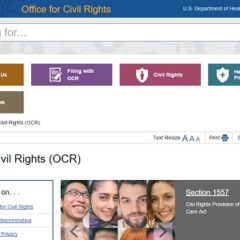
OCR Website Receives Long Awaited Upgrade
The Department of Health and Human Services’ Office for Civil Rights website has been redesigned and upgraded and features a responsive design and a more user-friendly interface. The redesign was part of the Reimagined HHS.gov initiative. The aim was to create a website that is faster, easier to use, and makes content sharing and syndication much more straightforward. The HHS site-wide overhaul has taken well over a year so far, with the OCR the first HHS department to receive its site upgrade. The upgrade and redesign was conducted in phases, with phase 1 of the project completed in May 2015. OCRs overhaul was finished on schedule and was made live this week in time for the January 6 launch. The new crisp, clean, and simplistic design presents information clearly, while a fast and powerful search function has been incorporated to ensure visitors can quickly and easily gain access to the information they need. Typing in a search term will offer numerous suggestions based on the most common searches of the site, ensuring the most relevant information can be quickly retrieved. In...
Exposure of PHI Grounds to Sue for Damages, Rules Mass. Judge
A data breach that exposes sensitive Protected Health Information may not necessarily result in patients coming to harm, or suffering an injury or loss. However, breach victims do face an elevated risk of suffering harm and losses. Many will even incur costs as a result of actions taken to reduce the risk of losses being suffered. It is not uncommon for data breach victims to attempt to recover damages from healthcare providers who have exposed their sensitive health data, but it is rare for those lawsuits to succeed or even be heard. In order to successfully sue a healthcare provider or health insurer for a data breach, the plaintiff must be able to produce evidence that losses have been suffered, or at the very least, that data have actually been viewed by unauthorized individuals. However, a Mass. Superior Court judge has recently ruled that a plaintiff does actually have grounds to sue for damages, even if evidence of harm or loss cannot be produced. The exposure of PHI alone can be grounds to claim damages. The ruling came on the case of Walker et al v. Boston Medical Center...
Breach of Washington Township Health Care District Data
Almost three months after suffering a breach of personal information, Washington Township Health Care District has submitted a breach notice to the California Attorney General’s Office detailing a breach of personal information of California residents. The data breach was discovered on October 8, 2015, and involved the potential accessing of a Washington Community Health Resource Library computer by an unauthorized individual. A library identification card database was potentially compromised in the incident. The database contained names, addresses, and driver’s license numbers. No other data were accessed or compromised in the security breach. An investigation was launched upon discovery of the security breach and an external computer forensics firm was contracted in this regard. While no evidence was uncovered to suggest the database file was accessed, it remains a possibility. In response to the breach, information security policies are being reviewed and will be updated, as necessary, to strengthen security. It is not clear at this point in time how many individuals were...
HIPAA Privacy Rule Updated to Permit NICS Reports
The Department of Health and Human Services has issued a final rule permitting certain covered entities to disclose specific elements of Protected Health Information (PHI) to the National Instant Criminal Background Check System (NICS), changing the HIPAA Privacy Rule. At the time of writing, the HIPAA Privacy Rule prevents healthcare providers from disclosing PHI, except in a very limited number of circumstances, without first having obtained permission from a patient. The rule change, which will become effective 30 days after publication in the federal register, will allow certain information about individuals to be divulged and entered into NICS by some HIPAA-covered entities. NICS is maintained by the FBI and is used by Federal Firearms Licensees (FFLs) to determine whether an individual is permitted to purchase a firearm. When an FFL starts a NICS background check on an individual, the system will search three separate databases: The Interstate Identification Index (III), The National Crime Information Center (NCIC), and the NICS Index. NCIC and III contain information on...
California Patient Privacy Law Enforcement is Inconsistent
Last week, California’s enforcement of data privacy rules was criticized after the Department of Public Health was found to be inconsistently enforcing state laws. Numerous healthcare organizations have committed serious privacy violations, yet have escaped fines. Two privacy bills were passed in California in 2008 in an effort to better protect the privacy of state residents. One of the aims was to make healthcare organizations more accountable when privacy violations occurred. The laws were introduced following a number of high profile privacy breaches involving hospital employees snooping on the medical records of celebrities (Britney Spears, Farrah Fawcett and Maria Shriver). Since the bills were passed, healthcare organizations in the state can receive heavy fines for privacy violations, although relatively few fines are issued. California Patient Privacy Laws Being Violated with Few Consequences The state of California has some of the strictest laws on data privacy in the country. While action is taken against healthcare organizations by the Department of Public Health when...

Get The FREE
HIPAA Compliance Checklist
Immediate Delivery of Checklist Link To Your Email Address
Please Enter Correct Email Address
Your Privacy Respected
HIPAA Journal Privacy Policy
Get The FREE
HIPAA Compliance Checklist
Immediate Delivery of Checklist Link To Your Email Address
Please Enter Correct Email Address
Your Privacy Respected
HIPAA Journal Privacy Policy




