Steve Alder



HHS Publishes New AI Strategy for Expanding AI Adoption
Last week, the Department of Health and Human Services (HHS) published its artificial intelligence (AI) strategy – a plan for increasing AI adoption within the HHS to improve efficiency and cut costs. The AI plan will see AI tools shared across all HHS departments, including the CDC, CMS, FDA, and NIH, with the goal of “supercharging internal operations through an AI-empowered workforce”. This approach, dubbed OneHHS, is intended to unify the HHS through shared AI infrastructure, streamline workflows, improve cybersecurity, and modernize the nation’s public health systems. While OneHHS has an initial internal focus, the HHS will seek to improve engagement with private sector stakeholders to develop new AI tools. The HHS strategy is based on five strategic pillars: Strengthening governance and risk management Developing infrastructure and platforms around users’ needs Promoting workforce development and burden reduction to improve efficiency Fostering health research and reproducibility through gold standard science Modernizing clinical and public health for better...

District Court Judge Blocks DOJ Subpoena for Medical Records of Transgender Children
Children’s Hospital of Philadelphia (CHOP) has won a legal challenge against the Department of Justice (DOJ) over a request for access to the protected health information of child-patients who received gender affirming care at CHOP. District Court Judge Mark Kearney ruled that the requests for patient data were “beyond the authority granted by Congress.” CHOP filed the lawsuit in the District Court for the Eastern District of Pennsylvania in response to a DOJ subpoena for fifteen categories of records related to gender-affirming care provided by CHOP. The records were requested as part of an investigation into the labeling and distribution of prescribed clinically authorized puberty blockers and hormone therapy to identify potential fraud and unlawful promotion of hormones and puberty blockers for transgender children, in violation of the Food, Drug, and Cosmetic (FD&C) Act. CHOP was one of twenty healthcare providers to receive subpoenas from the DOJ requesting information on minor patients as part of its efforts to restrict federal funding for gender-affirming care. The DOJ...

Course for HIPAA
An effective training course for HIPAA is one of the most important investments an organization can make in protecting patient information and maintaining regulatory compliance, as it prepares workforce members for subsequent mandatory HIPAA training and better equips staff to understand, absorb, and apply workplace policies and procedures. What makes an effective training course for HIPAA can vary depending on the nature of an organization’s operations, the size of its workforce, and the diversity of roles. For example, in a larger healthcare organization in which teams of staff work together, a new member of the workforce will receive more on-the-job guidance about disclosing only the minimum necessary PHI from colleagues than if they were working for a small medical practice with minimal oversight. Conversely, a new member of a small medical practice’s workforce may not need to receive training on using AI in the workplace or the distinction between the roles and responsibilities of a HIPAA Privacy Officer and a HIPAA Security Officer because the practice manager wears both...

Effective use of the HHS OIG Exclusions List
The HHS OIG Exclusions List is a database of individuals and organizations that are prohibited from participating in federal health care programs, and healthcare providers participating in federal healthcare programs are advised to regularly check the HHS OIG Exclusions List to avoid penalties for non-compliance with §1128 of the Social Security Act. This article answers the following: What is the HHS Office of Inspector General? What is the HHS OIG Exclusions List? How is the OIG Exclusions List populated? Why check the OIG list for exclusions? What are the penalties for engaging excluded entities? How can providers mitigate the risk of a penalty? What other lists should be checked for exclusions? Conclusion: The importance of regularly checking for exclusions Addendum: Synonyms for the HHS OIG Exclusions List What is the HHS Office of Inspector General? The HHS Office of Inspector General (OIG) is a team of investigators, auditors, analysts, attorneys and cybersecurity specialists within the Department of Health and Human Services (HHS). The team’s roles are to investigate and...

Effective HIPAA Policy Management
HIPAA policy management has the objective of ensuring that policies and procedures implemented to comply with HIPAA are current, accessible, and applied consistently across the organization. Effective management of HIPAA policies is one of the most constructive ways in which organizations can support HIPAA compliance by ensuring policies and procedures are applied consistently across the organization. HIPAA covered entities and business associates must develop, implement, maintain, and review policies and procedures with respect to Protected Health Information (PHI) that are designed to comply with all applicable standards, implementation specifications, and other requirements of the HIPAA Administrative Simplification Regulations. In addition, organizations must provide HIPAA training on policies and procedures that are relevant to workforce members’ roles, and ensure all workforce members are aware of policies and procedures implemented to support compliance with the HIPAA Security Rule. Further training is also required when there is a material change to a policy or procedure....

Get The FREE
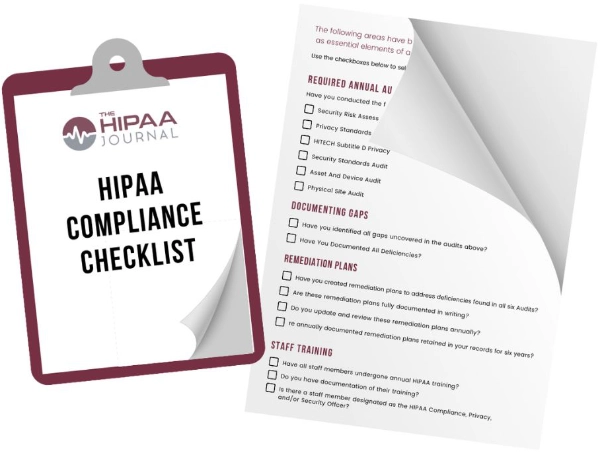
HIPAA Compliance Checklist
Immediate Delivery of Checklist Link To Your Email Address
Please Enter Correct Email Address
Your Privacy Respected
HIPAA Journal Privacy Policy
Get The FREE
HIPAA Compliance Checklist
Immediate Delivery of Checklist Link To Your Email Address
Please Enter Correct Email Address
Your Privacy Respected
HIPAA Journal Privacy Policy