Steve Alder



Email Data Breaches Reported by Three HIPAA-Regulated Entities
Email-related HIPAA breaches have been announced by Iron County Medical Center in Missouri, Regional Center of the East Bay in California, and Winkler County Hospital District in Texas. Iron County Medical Center, Missouri Iron County Medical Center in Pilot Knob, Missouri, has recently issued notification letters about a December 2024 email security incident. On December 6, 2024, two employees reported receiving a suspicious email from another Iron County employee. The IT team immediately terminated all active sessions within its email tenant to block any potential unauthorized access and launched an investigation into the potential email breach. A third-party digital forensics firm was engaged to investigate and confirmed that an unauthorized individual had accessed a single employee email account. The unauthorized activity appeared to involve only sending two emails internally. No evidence was found to indicate any further unauthorized activity, including any copying of emails in the compromised account. The compromised account was reviewed and found to contain the protected...

The Complicated Nature of BA Compliance
When a HIPAA covered entity contracts a service from a third party – or engages a third party to provide a service on the covered entity’s behalf – and the service involves the disclosure of Protected Health Information (PHI), it is necessary for the two parties to enter into a Business Associate Agreement (BAA). However, deciding what should in in a Business Associate Agreement and ensuring the Terms of the Agreement are complied with can be complicated. In the healthcare industry, the term BA compliance refers to a third party service provider (the “business associate”) complying with the terms of a Business Associate Agreement entered into with a covered entity. While, in theory, BA compliance should be straightforward, this is not always the case – and sometimes, noncompliance is not the fault of the business associate. This article aims to help you – a covered entity – understand how to engage with business associates in a HIPAA compliant way, and what needs to be in your HIPAA Business Associate Agreement. You can use this guide in conjunction with...

Community Care Alliance Agrees to Pay $1.09 Million to Settle Class Action Ransomware Lawsuit
Woonsocket, RI-based Community Care Alliance has agreed to pay $1,090,000 to resolve a class action lawsuit over a July 2024 ransomware attack by the Rhysida ransomware group. Rhysida is a ransomware group that engages in double extortion tactics, stealing data and encrypting files. A ransom demand is issued, payment of which is required to obtain the decryption keys and to have the stolen data deleted. In contrast to many other groups that simply leak the stolen data if the ransom is not paid, Rhysida holds auctions and attempts to sell the stolen data, only leaking the stolen data if a sale cannot be secured. Rhysida claimed to have exfiltrated a 2.5 terabyte database in the attack. Community Care Alliance discovered the attack on July 6, 2024, and determined that the ransomware group had access to its network from July 1, 2024, to July 5, 2024. During that time, data was exfiltrated, including names, addresses, birth dates, driver’s license numbers, Social Security numbers, diagnosis and condition information, lab test results, medications, health insurance information, and...

Ocuco Issues Notifications About 241K-Record Data Breach
Ocuco Inc. has published a substitute breach notice providing further information on its March 2025 cyberattack and data breach. Ocuco explained that it was first made aware of a potential data breach on April 1, 2025, when it was discovered that a third party, via a dark web posting, claimed to have stolen data from its network. Steps were immediately taken to secure its network, and an investigation was launched to assess the legitimacy of the claim. Assisted by third-party cybersecurity experts, Ocuco determined that a threat actor had accessed two non-production servers between March 28, 2025, and April 1, 2025. Those servers contained files, some of which were copied between March 30, 2025, and April 1, 2025. The investigation confirmed that the threat actor exploited a recently discovered vulnerability in third-party software for initial access. The vulnerability had not been timely disclosed to Ocuco. The review of the exposed files confirmed that they contained the information of 240,961 individuals. The exposed data varied from individual to individual and included names...
Is a Pharmacy a Covered Entity under HIPAA?
Yes, a pharmacy is a covered entity under HIPAA because it provides healthcare services and electronically transmits health information in connection with standard healthcare transactions such as billing, eligibility checks, and prescription processing. As covered entities, pharmacies are directly subject to the HIPAA Privacy Rule, HIPAA Security Rule, and HIPAA Breach Notification Rule, which govern how protected health information is used, disclosed, safeguarded, and reported if compromised. Pharmacies routinely handle protected health information when dispensing medications, counseling patients, coordinating with prescribers, and submitting claims to health plans. This information includes patient names, prescription details, insurance data, and clinical information, all of which must be protected against improper access or disclosure. HIPAA requires pharmacies to limit the use and disclosure of this information to the minimum necessary, except where broader use is permitted for treatment, payment, or healthcare operations. HIPAA Training for Pharmacy Staff Our training provides...

Get The FREE
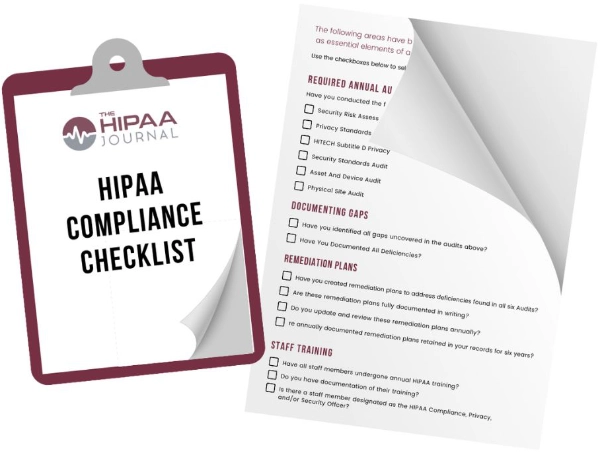
HIPAA Compliance Checklist
Immediate Delivery of Checklist Link To Your Email Address
Please Enter Correct Email Address
Your Privacy Respected
HIPAA Journal Privacy Policy
Get The FREE
HIPAA Compliance Checklist
Immediate Delivery of Checklist Link To Your Email Address
Please Enter Correct Email Address
Your Privacy Respected
HIPAA Journal Privacy Policy