
Steve Alder



Health Information Privacy Reform Act Advanced by HELP Committee
The Health Information Privacy Reform Act, introduced last year to improve privacy protections for health data not currently protected by the HIPAA Rules, has been advanced by a Senate committee. The legislation was proposed by Senate Health, Education, Labor, and Pensions (HELP) Committee Chair Sen. Bill Cassidy in November 2025, and an amended version of the bill was advanced by the HELP Committee by a 22-0 vote. The bill will now proceed to a full Senate vote. “Protecting patient information is essential to delivering quality care,” said Dr. Cassidy. “Smartwatches and health apps are helpful tools but open the door to privacy concerns that didn’t exist when it was just a patient and a doctor in an exam room. This bipartisan legislation ensures Americans’ data is secure and only collected and used with their consent.” The Health Insurance Portability and Accountability Act (HIPAA) regulates personally identifiable health information created, stored, maintained, or transmitted by healthcare providers, health plans, healthcare clearinghouses and their business associates; however,...

What is the Emergency Medical Treatment and Labor Act (EMTALA)?
The Emergency Medical Treatment and Labor Act (EMTALA) is a federal law that requires qualifying healthcare providers in the Medicare and Medicaid programs to stabilize and treat any individual presenting at an emergency department with an emergency medical condition, regardless of the individual’s insurance status or ability to pay. The Emergency Medical Treatment and Labor Act (EMTALA) was passed in 1986 as part of the larger Consolidated Omnibus Budget Reconciliation Act (COBRA). Since its passage, EMTALA has been amended several times to clarify the initial ambiguity of the Act, close regulatory loopholes that were used to avoid compliance, and support increased enforcement action. Background to the Emergency Medical Treatment and Labor Act (EMTALA) Prior to the passage of EMTALA, emergency medical provisions already existed for individuals lacking insurance or funds to pay for treatment. The Hospital Survey and Construction Act of 1946 made it a condition of federal funding that hospitals provide a “reasonable volume of free care” to residents of local communities who could...

Free Webinar: HIPAA Compliant Email – What you Actually Need (Without an IT Team)
Small healthcare practices often assume their emails are HIPAA-compliant; however, security gaps are often found to exist that threaten patient privacy and put practices at risk of regulatory penalties. The security gaps in email are easy for small practices to miss, as they are focused on running their practices and often lack in-house IT staff with email security expertise. Addressing these gaps is vital to ensure the privacy of patient information and compliance with the HIPAA Rules; however, implementing secure and HIPAA-compliant email systems can be technically challenging without an IT department, and secure email solutions can make accessing emails burdensome for patients. The webinar was on August 7, 2026 but a recording is available on demand, small healthcare practices will learn how to make their emails HIPAA-compliant without an IT team, while ensuring that patients can read securely transmitted emails without first logging into a secure portal. The 1-hour webinar will cover what HIPAA demands for email for small practices, why free Gmail and Microsoft 365 email are...

Ransom Cartel Mastermind Sentenced to 16 Years in Prison
The Belarusian cybercriminal behind the Ransom Cartel ransomware group has been sentenced to 16 years in prison for his role in ransomware attacks on at least 18 companies worldwide. Maksim Silnikau, 40, was the creator and administrator of the Ransom Cartel ransomware-as-a-service operation and recruited other cybercriminals to conduct ransomware attacks globally. According to court documents, Silnikau began developing the ransomware operation in May 2021, initially under a different name, before rebranding it as Ransom Cartel in 2022. Between 2021 and 2023, along with his co-conspirators, at least 18 companies fell victim to attacks, including companies in California, New York, and Nebraska. The attacks caused more than $6.7 million in losses, and the group attempted to extort at least $5.2 million from victims. Silnikau did not conduct many of the intrusions himself. He was the administrator of the operation and purchased stolen credentials from initial access brokers, recruited affiliates to conduct attacks, negotiated with victims, used cryptocurrency mixers to hide the...

Settlements Resolve Data Breach Lawsuits Against McKenzie Health System & Aspire Health Alliance
Settlements have been agreed to resolve class action data breach lawsuits against McKenzie Health System in Michigan and Aspire Health Alliance in Massachusetts. McKenzie Health System Data Breach Settlement McKenzie Health System, the operator of the McKenzie Memorial Hospital, a critical access hospital in Sanilac County, Michigan, has settled a class action lawsuit that was filed in response to an April 2025 cyberattack and data breach. McKenzie Health identified unauthorized access to its computer network on April 15, 2025. The forensic investigation determined that an unauthorized third party accessed its network between April 14, 2025, and April 15, 2025, and potentially obtained files containing patient information. Data potentially compromised in the incident included names, addresses, birth dates, Social Security numbers, patient account numbers, medical record numbers, diagnosis and treatment information. The data breach was reported to the HHS’ Office for Civil Rights as affecting 58,839 individuals, who started to be notified on or around July 24, 2025. Several class...

Get The FREE
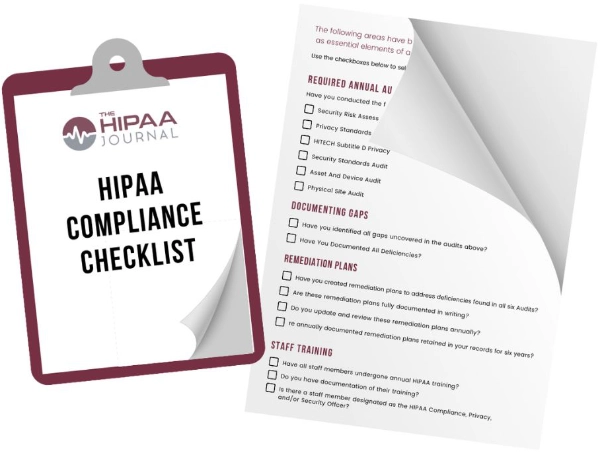
HIPAA Compliance Checklist
Immediate Delivery of Checklist Link To Your Email Address
Please Enter Correct Email Address
Your Privacy Respected
HIPAA Journal Privacy Policy
Get The FREE
HIPAA Compliance Checklist
Immediate Delivery of Checklist Link To Your Email Address
Please Enter Correct Email Address
Your Privacy Respected
HIPAA Journal Privacy Policy