Steve Alder



AmGen Announces Cyberattack and Data Breach Involving Patient Data
Amgen Inc., a Thousand Oaks, CA-based biopharmaceutical company that develops and manufactures pharmaceutical products for oncological, hematological, and cardiovascular diseases, has recently disclosed a cybersecurity incident involving unauthorized access to third-party-hosted cloud storage systems. In a Form 8-K filing with the U.S. Securities and Exchange Commission (SEC), Amgen explained that it determined in July 2026 that hackers gained access to certain cloud systems. Amgen immediately implemented its cybersecurity response plan, deployed containment measures, and engaged third-party digital forensics experts to determine the nature and scope of the unauthorized activity. The investigation determined that proprietary data, patients’ protected health information, and other data had been exfiltrated from the cloud environment, and on July 29, 2026, determined that the incident was material and informed the SEC. Amgen said it does not believe the incident is reasonably likely to have an impact on its financial position, nor any of its products, manufacturing operations,...

CISA Issues Updated Guidance on Minimum Elements of an SBOM
The U.S. Cybersecurity and Infrastructure Security Agency (CISA), Federal Bureau of Investigation (FBI), National Security Agency (NSA), and 15 international cybersecurity authorities have published joint guidance on the minimum elements of a Software Bill of Materials (SBOM). An SBOM is a detailed list of software components, including open-source libraries and hidden dependencies, together with the creators or vendors associated with those components. Software supply chains are often large and complex, and vendors can be slow to release patches to address vulnerabilities, especially when those vulnerabilities affect third-party components. Cybercriminals target software supply chains as they often have ample time to exploit vulnerabilities before patches are released. Keeping up to date with vendor patches is important; however, simply applying vendor patches does not guarantee that the software is secure. If an SBOM is obtained from a software vendor, users will be able to identify vulnerable or risky components long before patches are released by vendors, allowing them to...

Health-ISAC Warns of Increasing ShinyHunters Healthcare Data Theft Attacks
Health sector organizations have been warned about an increase in successful attacks by the ShinyHunters threat group. In contrast to ransomware actors, ShinyHunters conducts supply chain and identity attacks, targeting cloud SaaS and storage platforms. The group is focused on cloud-scale data exfiltration, with initial access typically achieved by voice-based social engineering (vishing) to reset passwords, MFA, or enroll new devices, according to a recent Health-ISAC cybersecurity alert. Once account access is gained, they log in to the organization’s Okta, Microsoft Entra, or Google SSO dashboard, which lists all applications the account holder has access to, such as Microsoft 365, Salesforce, Dropbox, Google Drive, and other third-party platforms. Data is rapidly exfiltrated, and victims are advised about the data theft. ShinyHunters demands a ransom payment to prevent the stolen data from being leaked on the group’s dark web data leak site. In recent months, ShinyHunters has conducted successful attacks on several healthcare and medtech companies, including the medical device...
What is the False Claims Act in Healthcare?
The False Claims Act in healthcare is a law that can be used by government agencies to take enforcement action against contractors who knowingly submit false claims, cause another to submit false claims, or knowingly make a false record or statement to get a false claim paid by a federal healthcare program. False Claims Act healthcare complaints can also be filed against contractors who fail to return Medicare and Medicaid overpayments. The False Claims Act was enacted in 1863 “to prevent and punish frauds upon the Government of the United States”. The Act was introduced with the intention of stopping dishonest contractors selling faulty supplies and equipment to Union troops during the Civil War. Significantly, the Act included a “qui tam” provision which permits private citizens to sue dishonest contractors on behalf of the government and retain a percentage of the proceeds. Despite the availability of the Act, successive Attorneys General mostly ignored it – preferring instead to pursue criminal prosecutions against dishonest contractors rather than civil prosecutions. This...

OSF Healthcare System Pays $552,250 to Settle OCR HIPAA Investigation
OSF Healthcare System and its Affiliated Covered Entities (OSF Healthcare) have agreed to pay a penalty of $552,250 to resolve alleged violations of the HIPAA Privacy, Security, and Breach Notification Rules. OSF Healthcare is a Peoria, Illinois-based integrated health system that serves patients at 174 locations in Illinois and Michigan, including 16 hospitals. On April 23, 2021, OSF Healthcare discovered that ransomware had been used to encrypt files on its network. The threat group deployed a variant of Nephilim ransomware to encrypt files and demanded payment to prevent a data leak and to obtain the keys to unlock the encrypted files. The forensic investigation determined on August 24, 2021, that the protected health information (PHI) of 53,907 patients was exfiltrated from its network, including names, driver’s license numbers, diagnosis and treatment information, prescription information, medical record numbers, provider names, dates of services, financial account information, and health insurance information. OCR was notified about the attack on October 1, 2021, and...

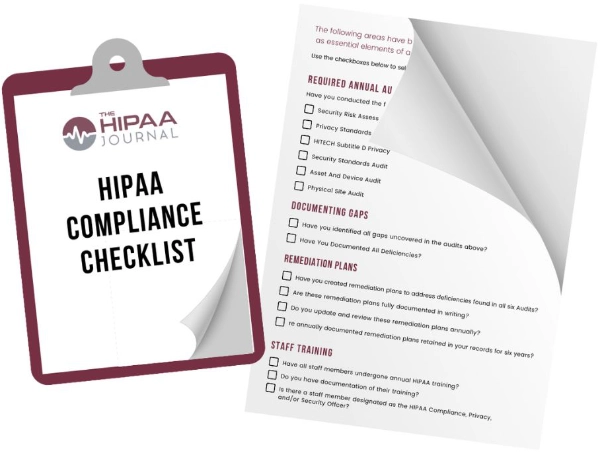
Get The FREE
HIPAA Compliance Checklist
Immediate Delivery of Checklist Link To Your Email Address
Please Enter Correct Email Address
Your Privacy Respected
HIPAA Journal Privacy Policy
Get The FREE
HIPAA Compliance Checklist
Immediate Delivery of Checklist Link To Your Email Address
Please Enter Correct Email Address
Your Privacy Respected
HIPAA Journal Privacy Policy