
Steve Alder


Saltzer Health Alerts Patients About PHI Exposure in Email Account Breach
Nampa, Idaho-based Saltzer Health has started notifying certain patients that some of their protected health information (PHI) has been exposed in an email account breach that was detected on June 1, 2021. The investigation revealed an unauthorized individual had access to an employee’s email account between May 25, 2021, and June 1, 2021. Saltzer Health was unable to find evidence indicating the attacker viewed or exfiltrated emails from the account, but it was not possible to rule the possibility of unauthorized PHI access and data theft. The investigation confirmed the breach was confined to a single email account and no other systems were affected. Assisted by third-party specialists, Saltzer Health conducted a comprehensive review of the email account to determine which patients had been affected. The review was completed on September 21, 2021, and revealed the following types of patient data were stored in the account: Names, contact information, state identification numbers, driver’s license numbers, medical record numbers, medical histories, diagnoses, treatment...
92% of IT Leaders Guilty of Password Reuse
A recent survey has revealed password reuse is rife, even amongst IT leaders who should know better. 92% of IT leaders admitted to reusing passwords for multiple accounts, even though this is a significant security risk. Password best practices include setting a strong, unique password for each account. If passwords are reused across multiple accounts, all it takes is for one of those accounts to be compromised for all other accounts that use that password to be accessed. Password reuse is exploited in credential stuffing attacks, where threat actors use lists of passwords obtained in previous data breaches to try to gain access to other accounts. These attacks are automated, often using multiple IPs to try small numbers of passwords to avoid being locked out of accounts. The survey was conducted by the password manager provider Bitwarden, which also found that other poor password practices were common. 53% of respondents stored passwords in documents on their computers, and 29% wrote their passwords down to make sure they did not forget them. 53% of IT decision-makers said they...

Avalon Healthcare Settles HIPAA Case with Oregon and Utah State AGs and Pays $200,000 Penalty
Avalon Healthcare has agreed to settle alleged violations of the Health Insurance Portability and Accountability Act (HIPAA) and state laws with the Oregon and Utah Attorneys General that were uncovered during an investigation of a 2019 breach of the personal and protected health information of 14,500 of its employees and patients. Avalon Healthcare is part of the Avalon Health Care Group and provides skilled nursing, therapy, senior living, assisted living, and other medical services throughout Oregon, Utah, California, Nevada, Washington, and Hawaii. In July 2019, an employee responded to a phishing email and disclosed credentials that allowed an email account to be accessed by unauthorized individuals. The account contained sensitive information such as names, addresses, Social Security numbers, dates of birth, driver’s license numbers, medical treatment information, and some financial information. It took 10 months from the date of the breach for the incident to be reported to the HHS and state attorneys general, and for affected individuals to be notified. Oregon Attorney...
Healthcare Supply Chain Association Issues Guidance on Medical Device and Service Cybersecurity
The Healthcare Supply Chain Association (HSCA) has issued guidance for healthcare delivery organizations, medical device manufacturers, and service suppliers on securing medical devices to make them more resilient to cyberattacks. The use of medical devices in healthcare has grown at an incredible rate and they are now relied upon to provide vital clinical functions that cannot be compromised without diminishing patient care. Medical devices are, however, often vulnerable to cyber threats and could be attacked to cause harm to patients, be taken out of service to pressure healthcare providers into meeting attackers’ extortion demands, or could be accessed remotely to obtain sensitive patient data. Medical devices are often connected to the Internet and can easily be attacked, so it is essential for proactive steps to be taken to improve security. The HSCA represents healthcare group purchasing organizations (GPOs) and advocates for fair procurement practices and education to improve the efficiency of purchases of healthcare goods and services and, as such, has a unique line of...

Largest Healthcare Data Breaches of 2021
The largest healthcare data breaches of 2021 rank as some of the worst of all time. In this post, we summarize some of the most serious data breaches to be reported in what has turned out to be another record-breaking year. The Department of Health and Human Services’ Office for Civil Rights’ breach portal shows 686 HIPAA compliance data breaches of 500 or more records in 2021, and that number is likely to grow over the next couple of weeks and could well exceed 700 data breaches. As it stands, 2021 is already the worst ever year for healthcare data breaches, beating last year’s record of 642 data breaches. It has also been a particularly bad year in terms of the number of breached healthcare records. Across the 686 2021 healthcare data breaches, 44,993,618 healthcare records have been exposed or stolen, which makes 2021 the second-worst year in terms of breached healthcare records. There have been 245 data breaches of 10,000 or more records, 68 breaches of the healthcare data of 100,000 or more individuals, 25 breaches that affected more than half a million...

Get The FREE
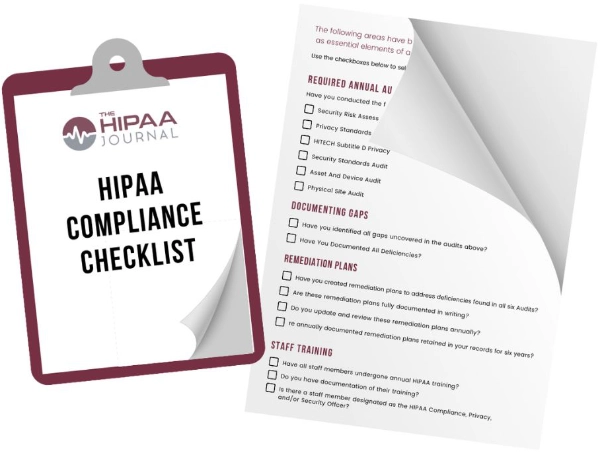
HIPAA Compliance Checklist
Immediate Delivery of Checklist Link To Your Email Address
Please Enter Correct Email Address
Your Privacy Respected
HIPAA Journal Privacy Policy
Get The FREE
HIPAA Compliance Checklist
Immediate Delivery of Checklist Link To Your Email Address
Please Enter Correct Email Address
Your Privacy Respected
HIPAA Journal Privacy Policy