

Steve Alder


OCR Warns of Postal Scam Targeting HIPAA Compliance Officers
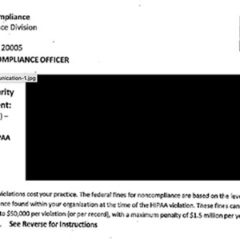
The Department of Health and Human Services’ Office for Civil Rights is warning healthcare organizations about a potential phishing scam being conducted by mail that has been designed to scare compliance officers into visiting a website or taking other immediate action with respect to a mandatory HIPAA risk assessment. Postcards have been sent to several healthcare organizations that masquerade as an official communication from the Office for Civil Rights. The postcards are addressed to the HIPAA compliance officer and state a mandatory HIPAA compliance risk assessment must be performed. The postcards warn that “HIPAA violations cost your practice. The federal fines for noncompliance are based on perceived negligence found within your organization at the time of the HIPAA violation.” The postcards remind the recipient that “fines can range from $100 to $50,000 per violation (or per record), with a maximum penalty of $1.5 million per year for each violation.” The postcards claim to have been sent by the Secretary of Compliance of the HIPAA Compliance Division – a position that does...
Children’s Hospital Colorado Suffers Phishing Attack
Children’s Hospital Colorado is notifying 2,553 patients that some of their protected health information was stored in an email account that was accessed by an unauthorized individual between April 6-12, 2020. Credentials to access the account were obtained when an employee responded to a phishing email. The phishing attack was identified by the hospital on June 22, 2020 and the account was immediately secured. A review of the emails and email attachments in the account revealed they contained patient names, zip codes, dates of service, medical record numbers, and clinical diagnosis information. Steps have since been taken to harden email security defenses, platforms are being evaluated for educating staff on cybersecurity, and technical controls related to email are also being reviewed. Stolen Hoag Clinic Laptop Contained Unencrypted PHI On June 5, 2020, a laptop computer issued to an employee of the Hoag Clinic in Costa Mesa, CA was stolen from a vehicle parked in the worksite parking lot in Newport Beach. The theft was discovered the same day and law enforcement was...
PHI Exposed in Phishing Attacks on FHN and Elkins Rehabilitation & Care Center
The Freeport, IL-based healthcare system FHN is notifying certain patients that some of their protected health information has potentially been obtained by an unauthorized individual who gained access to the email accounts of several employees between February 12 and February 13, 2020. FHN announced on April 20, 2020 that the investigation had confirmed that a breach occurred, but it took time to determine the information that may have been viewed or obtained. It was not possible to determine whether patient information contained in the accounts was viewed or obtained, but data access could not be ruled out. Affected individuals were notified on July 31, 2020. The compromised accounts contained names, dates of birth, health insurance information, medical record numbers, patient account numbers, and limited treatment and/or clinical information, such as provider names, diagnoses, and medication information. A limited number of Social Security numbers and driver’s license numbers were also potentially compromised. The PHI of 4,120 patients was exposed. Complimentary credit monitoring...
House of Representatives Votes to Remove Ban on HHS Funding a National Patient Identifier System
The House of Representatives has voted to lift the ban on the Department of Health and Human Services using federal funds to develop a national patient identifier system. The Health Insurance Portability and Accountability Act (HIPAA) called for the development of a national patient identifier system. As the name suggests, a national patient identifier system would see each person in the United States issued with a permanent, unique identification number, similar to a Social Security number, that would allow each patient to be identified across the entire healthcare system in the United States. If a patient from California visited an emergency room in New York, the patient identifier could be used to instantly identify the patient, allowing the healthcare provider to access their medical history. Currently, the lack of such an identifier makes matching patients with their medical records complicated, which increases the potential for misidentification of a patient. The extent to which records are mismatched has been shown in multiple studies. For instance, in 2012, a study...
FBI Urges Enterprises to Upgrade Windows 7 Devices to a Supported Operating System
The FBI Cyber Division has issued a Private Industry Notification advising enterprises still using Windows 7 within their infrastructure to upgrade to a supported operating system due to the risk of security vulnerabilities in the Windows 7 operating system being exploited. The FBI has observed an increase in cyberattacks on unsupported operating systems once they reach end-of-life status. Any organization that is still using Windows 7 on devices faces an increased risk of cybercriminals exploiting vulnerabilities in the operating system to remotely gain network access. “As time passes, Windows 7 becomes more vulnerable to exploitation due to lack of security updates and new vulnerabilities discovered,” warned the FBI. The Windows 7 operating system reached end-of-life on January 14, 2020 and Microsoft stopped releasing free patches to correct known vulnerabilities. Microsoft is only providing security updates for Windows 7 Professional, Windows 7 Enterprise, and Windows 7 Ultimate if users sign up for the Extended Security Update (ESU) program. The ESU program will only run...

Get The FREE
HIPAA Compliance Checklist
Immediate Delivery of Checklist Link To Your Email Address
Please Enter Correct Email Address
Your Privacy Respected
HIPAA Journal Privacy Policy
Get The FREE
HIPAA Compliance Checklist
Immediate Delivery of Checklist Link To Your Email Address
Please Enter Correct Email Address
Your Privacy Respected
HIPAA Journal Privacy Policy




