

Steve Alder


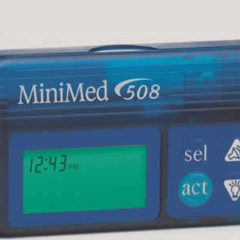
Medtronic Recalls Insulin Pumps Due to Cybersecurity Risk
The United States Computer Emergency Readiness Team (US-CERT) and the Food and Drug Administration (FDA) have issued alerts about cybersecurity flaws in certain Medtronic insulin pumps. The affected insulin pumps connect with other devices such as blood glucose meters, glucose sensor transmitters, and CareLink USB devices using wireless RF. Vulnerabilities have been identified in certain MiniMed 508 and MiniMed Paradigm insulin pumps which could allow an attacker with adjacent access to an affected product to intercept, modify, or interfere with the RF communications to or from the product. Consequently, it would be possible to read data sent to and from the device, alter the settings of the insulin pump, and take control of insulin delivery. An attack could therefore result in hypoglycemia, diabetic ketoacidosis, or death. The flaw – CVE-2019-10964 – is due to the communications protocol not properly implementing authentication or authorization and has been assigned a CVSS v3 base score of 7.1 out of 10. The flaw was uncovered by security researchers Nathanael Paul,...
HELP Committee Approves Bill Calling for HIPAA Enforcement Safe Harbor
The Senate Health, Education, Labor and Pensions (HELP) Committee has approved the Lower Health Care Costs (LHCC) Act of 2019, which has implications for HIPAA-covered entities. One of the main aims of the bill is to improve transparency of health care costs and service quality. The bill is intended to end surprise health bills and make sure patients are kept well informed about healthcare costs. The LHCC Act includes a provision that incentivizes healthcare organizations to adopt strong cybersecurity practices by calling for the Department of Health and Human Services’ Office for Civil Rights to consider the organization’s good faith security efforts when making decisions about enforcement actions. The bipartisan bill passed the HELP committee by 20 votes to 3. The bill includes 54 different proposals from 65 senators. With the bill now passed, HELP committee chairman Lamar Alexander (R-Tenn) hopes to present the bill to the Majority and Minority Leaders for consideration by the full senate in July. Many healthcare organizations have been calling for OCR to consider adoption of...
OCR Clarifies Allowable Uses and Disclosures of PHI for Care Coordination and Continuity of Care
The Department of Health and Human Services’ Office for Civil Rights has issued new HIPAA guidance for health plans on how protected health information can be shared to support care coordination and continuity of care. The guidance, which is in the form of an FAQ, answers two questions commonly asked by health plans: Can PHI be disclosed to another health plan for care coordination purposes? OCR has confirmed that the HIPAA Privacy Rule allows PHI to be used and disclosed for healthcare operations, so it is possible to share PHI with another health plan or other covered entity if doing so is necessary for the entity’s own healthcare operations. PHI can also be shared with another health plan for the recipient’s healthcare operations provided the following conditions are met: Both entities have or had a relationship with the individual, the disclosure pertains to that relationship, and the healthcare operation is one permitted by HIPAA (See 45 CFR 164.502(a)(1)(ii); 45 CFR 164.506(c)(4)) Case management and care coordination are included in permitted ‘healthcare operations,’ so they...
Patient Care Coordinator Gets 1 Year Jail Term for HIPAA Violation
A former patient care coordinator at University of Pittsburgh Medical Center (UPMC) has received a 1-year jail term for accessing the medical records of patients and using that information to cause malicious harm contrary to HIPAA. Sue Kalina, 62, of Butler, PA, had previously worked at UPMC Tri Rivers Musculoskeletal and Allegheny Health Network as a patient care coordinator. On March 30, 2016, while employed by UPMC, Kalina first started accessing patients’ medical records without authorization. She continued to do so until June 15, 2017. Kalina accessed the records of friends, old classmates, and individuals that she had a grievance with. She used information from the medical records in a campaign of vengeance against her former employer, Frank J. Zottola Construction. Kalina had worked at the firm as office manager for 24 years before losing the position and being replaced by a younger woman. Kalina accessed that woman’s medical records and disclosed gynecological information about the woman to the Zottola controller in June 2017. Kalina also left a voicemail message in which...
2,200 Franciscan Health Patients Notified of Unauthorized PHI Access by Employee
Mishawaka, IN-based Franciscan Health has discovered the protected health information of approximately 2,200 patients has been accessed by a former employee without authorization. The privacy violation was discovered during a routine privacy audit. Franciscan Health announced that it was confirmed on May 24, 2019, that an employee in the quality research department had accessed the electronic medical records of patients without authorization and with no legitimate work reason for doing so. The individual concerned is no longer employed by Franciscan Health and the matter has been reported to law enforcement. While unauthorized PHI access was confirmed, Franciscan Health found no evidence to suggest that the employee copied, transmitted, or disclosed any patient information. Patient information was stored in Franciscan Health’s medical record system, which has been in use since 2012. Through that system, the former employee accessed patient records containing information such as names, addresses, email addresses, dates of birth, phone numbers, gender information, race/ethnicity,...

Get The FREE
HIPAA Compliance Checklist
Immediate Delivery of Checklist Link To Your Email Address
Please Enter Correct Email Address
Your Privacy Respected
HIPAA Journal Privacy Policy
Get The FREE
HIPAA Compliance Checklist
Immediate Delivery of Checklist Link To Your Email Address
Please Enter Correct Email Address
Your Privacy Respected
HIPAA Journal Privacy Policy




