

Digital Marketing for Dentists
‘Digital marketing for dentists can help resolve “empty chair” issues by attracting new patients in order to fill gaps in schedules. However, although digital marketing can be one of the most cost-effective methods of attracting new patients and increasing profitability, dentists must be careful not to violate HIPAA or other state and federal regulations.
Each quarter, the American Dentistry Association Health Policy Institute publishes a report on the economic outlook and emerging issues in dentistry based on a survey of approximately one thousand private dentists (# responses varies each quarter). In the most recent report, one of the headline questions related to how busy dentists were over the last three months.
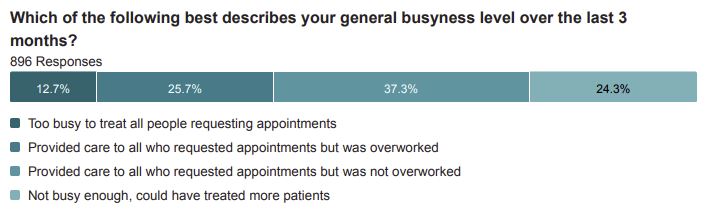
An analysis of those who responded “not busy enough” later in the report shows that gaps in schedules affect all types of dentists – i.e., solo practitioners, group practices, and DSOs. While some empty chair issues are attributable to no shows and last minute cancellations, 37% of respondents to the question “what prevented your appointment schedule from reaching 100% last week?” (Q4 2023) replied “not enough patients making appointments”.
The empty chair issue is exasperated by the average dental practice losing 15% of patients each year. Patient attrition can be explained by unavoidable events such as patients dying, relocating, or changing their insurers. They can also be explained by avoidable events such as the failure to preschedule future appointments, send appointment reminders, or maintain a market presence against more organized DSOs with well-resourced marketing teams.

Get The FREE
HIPAA Compliance Checklist
Immediate Delivery of Checklist Link To Your Email Address
Please Enter Correct Email Address
Your Privacy Respected
HIPAA Journal Privacy Policy

How Can Dentists Fill Appointment Schedules?
There are three ways dentists can fill appointment schedules – increase the frequency of appointments for existing patients, attract new patients, and reduce the patient attrition rate. The first option is limited due to restraints on insurance plan coverage. Many plans only permit two checkups per year. Few patients will schedule additional checkups if they consider them unnecessary and have to pay for them.
The second option is limited by the distance patients are willing to travel to see a dentist. There are more than 135,000 dental practices in the United States and, in some areas, there can be as many as five dental practices per square mile. According to Columbia University’s College of Dental Medicine, rural patients travel an average distance of 17.5 miles to see a dentist, as compared with urban populations’ 8.3 miles.
“Rural patients travel an average distance of 17.5 miles to see a dentist, as compared with urban populations’ 8.3 miles.” Source: Columbia University College of Dental Medicine.
Therefore, to fill appointment schedules, dentists must focus on attracting and retaining new patients in their local area by out-marketing competing dentists. Ways to do this include direct mailing, newspaper and radio advertising, and local PR (i.e., community activities and sponsorships). However, these marketing activities can be expensive and time-consuming with a low return on investment.
A more cost-effective way to out-market competing dentists is to take advantage of existing resources. Most dentists have websites, but it is not possible to accommodate every website at the top of search engine results pages (SERPs). Websites that get to the top of SERPs have a better chance of being found by potential patients, and the way to get to the top of SERPs is effective digital marketing for dentists.
What is Digital Marketing for Dentists?
Digital marketing for dentists is a multilayered approach to maximizing a dentist’s online presence. It consists of optimizing the content of a website and the website’s metadata to match keywords being searched for by potential patients, marketing the content of the website via Google Profiles, social media, and paid advertising, and managing online reviews to enhance the reputation of the practice.
Digital marketing for dentists can also include email marketing activities. However, email marketing activities have to be managed carefully to ensure they comply with the HIPAA marketing rules, and that they avoid impermissibly disclosing Protected Health Information (PHI). State and other federal regulations can also influence whether email marketing should be included in a digital marketing program for dentists.
With regards to HIPAA, any digital marketing activities that involve the creation, collection, storage, or transmission of PHI must be HIPAA compliant. This means that if a website collects patient information via a form or schedules appointments via a plug-in, the website, the form, the plug-in, and the way information is transmitted to – and stored by – a dentist that qualifies as a HIPAA covered entity must be HIPAA compliant.
Website Optimization
Website optimization consists of creating helpful, reliable, and “people-first” content while giving visitors to the website the best possible “page experience”. In the context of digital marketing for dentists, an example could be a keyword-rich explanation of a dental procedure that is supported by images or video, and that reassures visitors to each web page about the procedure so they are encouraged to book an appointment.
When creating content of this nature, it is important not to use deceptive or misleading language, contravene Internet spam policies, or give visitors unrealistic expectations. Deceptive or misleading language may draw the attention of the Federal Trade Commission, spam content will be penalized by search engines, and unrealistic expectations will result in dissatisfied patients posting negative online reviews about the practice.
With regards to optimizing the website’s metadata, each page of the website should have a meta-description that catches the eye. The meta-description is the portion of text that appears in search engine results pages and acts as the shop window for the web page. An informative meta-description can make all the difference between a potential patient visiting Dentist A’s website and Dentist B’s website.
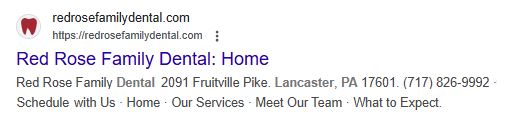
An example of an informative meta-description that includes the address and implies further information exists on the Home Page that would be of interest to prospective patients.
Google Profile Marketing
Google gives all service businesses the opportunity to register for a free Business Profile. When completed, the Profile provides essential information about what the business does, where it is, when it is open, and how it can be contacted. Then, when a potential patient conducts a location-based search (i.e., “dentists in Lancaster PA”), the results they receive will include the Business Profiles for dentists in that area and directions how to get there.
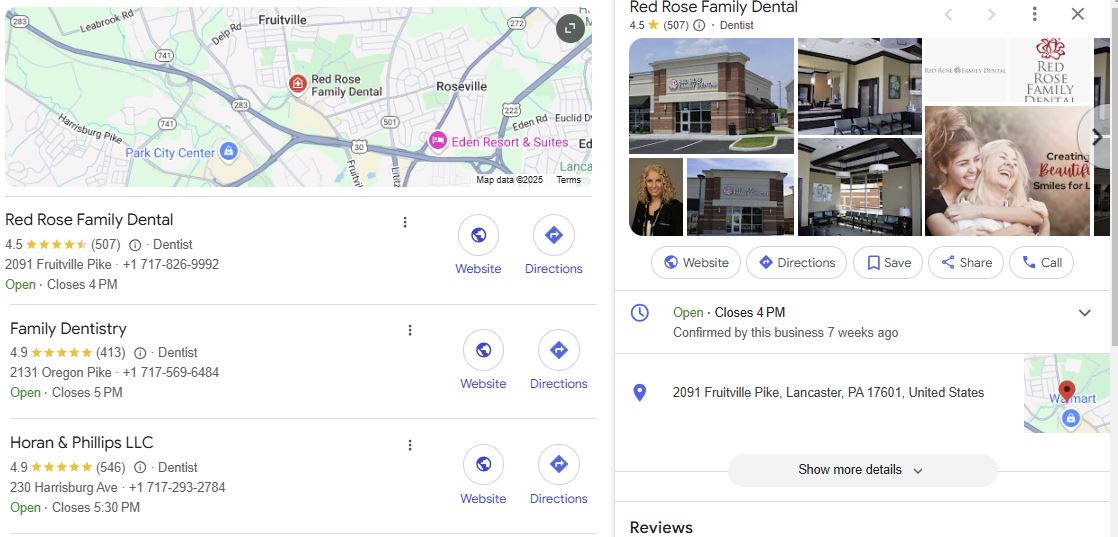
A selection of Google Business Profiles for dentists in Lancaster, PA.
Businesses can personalize the Profile with further information about the services they provide, images, videos, links to blog posts, and other attributes. It is also possible to create a link or QR code to the Business Profile to share on social media, use in email marketing, or to send to patients in follow-up communications after a treatment with a request to add a review to the Business Profile.
“Customers are 70% more likely to visit and 50% more likely to consider purchasing from businesses with a complete Business Profile.” Source: Google Support.
Social Media Content Marketing
Social media can be a valuable tool for increasing website traffic when it is used to market the content of websites. This is because when social media users search for information about a procedure or how to overcome a fear of dentistry, the algorithm used by the site will fill users’ timelines with related content. Even if some content is not relevant to users’ searches, they may know somebody for whom the content is relevant and share it with them.
In the context of digital marketing for dentists, video content marketing can be particularly lucrative as prospective patients would rather see how procedures are performed than read about them. It is relatively simple to create a video, post it to YouTube, embed the video into a website, and market the video content on social media channels. Note: This process will help a website perform better in SERPS than just posting a video on (i.e.,) TikTok.

When marketing content on social media, it is important to be conscious of legal, privacy, and security requirements because, once content is posted to social media, dentists have no control over how it may be used, further disclosed, or manipulated. Therefore, it may be necessary to review state dental board regulations and obtain a valid HIPAA authorization before publishing a patient testimonial on a website or social media.
One further consideration with regards to this type of digital marketing for dentists is to avoid interacting with social media users in responses to posts or in DMs. While it is important to respond to reviews (discussed below), it can be difficult to verify the identity of social media users, and it is conceivable that a dentist could disclose PHI to an individual who has created a fake profile to gain unauthorized access to the information.
Paid Online Advertising
One of the quickest ways to get to the top of SERPs and attract new patients is to pay for advertising. Search engine pay-per-click advertising gives dentists more control over when their website appears at the top of SERPs in order to minimize the cost of advertising. For example, controls can be applied so the website only appears at the top of SERPs when prospective patients within (for example) twenty miles of the practice search for a dentist.
While being at the top of SERPs does not guarantee a prospective patient will click on an ad and visit a website, the fact the practice’s name appears at the top of SERPs increases the practice’s brand recognition. This can help support other digital marketing activities inasmuch as when the practice’s name appears in a social media post, YouTube video, or online review, the name of the practice will already be familiar to a prospective patient.
“Pay-per-click traffic converts 50% better than organic traffic.” Source: cropink.com
This type of digital marketing for dentists does not have to be limited to search engine pay-per-click advertising. Dentists can also pay for online advertising on social media sites – several of which enable businesses to target ads on factors such as age, location, interests, and behavior. This enables dentists to create a range of ads for marketing and retargeting campaigns to reach potential patients who are interested in specific services.
Managing Online Reviews
Online reviews do not necessarily make or break a business’s reputation, but failing to manage them correctly can. It has been reported that 84% of patients read online reviews before choosing a new healthcare provider and 51% of patients read at least six reviews. With regards to the importance of managing reviews, 45% of patients noted that, when choosing a provider, they are swayed by whether doctors respond to reviews.
The importance of managing reviews may not be identical for dentists depending on the availability of dentists in an area, whether the dentists in the area accept the patient’s insurance, and the nature of the treatment required. Nonetheless, it can be beneficial to thank patients for their positive reviews and respond to negative reviews professionally to protect reputations and show potential patients a responsive and caring attitude.
One of the advantages of registering for a Google Business Profile is that it will be the first source of reviews most potential patients come across and dentists know where to prioritize the management of online reviews. However, reviews can be published on many other professional, commercial, and social media platforms. It is important for dentists to know all the locations where the practice is being discussed and what is being said about it.
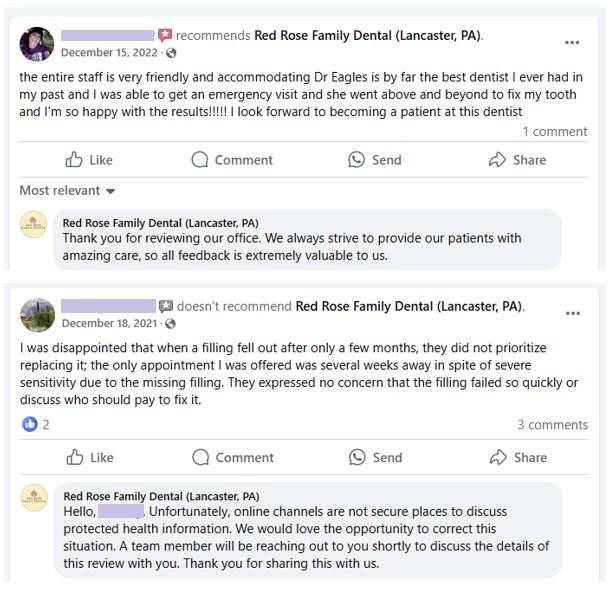
An example of responding to both positive and negative online reviews. Source: Facebook Red Rose Family Dental
With regards to the above responses, it is noticeable the practice commented “online channels are not secure places to discuss Protected Health Information”. In October 2019, a dental practice was fined $10,000 for impermissibly disclosing Protected Health Information in response to a negative review, while in 2022 HHS’ Office for Civil Rights settled two similar HIPAA violations by dentists for $23,000 and $50,000 respectively.
Email Marketing
It was previously mentioned that email marketing activities have to be managed carefully to ensure they comply with – or are exempted from – the HIPAA marketing rules. Because so few of the exemptions to HIPAA’s definition of marketing apply to dentists, and because emails containing PHI have to be transmitted through secure channels of communication, this type of digital marketing for dentists has limited opportunities.
Even when carefully worded appointment reminders are sent to patients, it may be necessary to obtain consent from a patient before communicating with them via email. In addition, several states have implemented privacy laws which require an “affirmative opt-in” before a dentist can communicate with patients by email. These include Connecticut, Colorado, Texas, Tennessee, Virginia, Utah, Montana, Iowa, and Indiana (from January 2026).
One further consideration before adopting this type of digital marketing for dentists is that misdelivered emails account for approximately 8% of all data breaches and impermissible disclosures notified to HHS’ Office for Civil Rights. To put this figure into context, in 2022, HHS’ Office for Civil Rights received 64,592 HIPAA breach notifications – implying that more than five thousand data breaches were attributable to misdelivered emails.
Performance Assessments
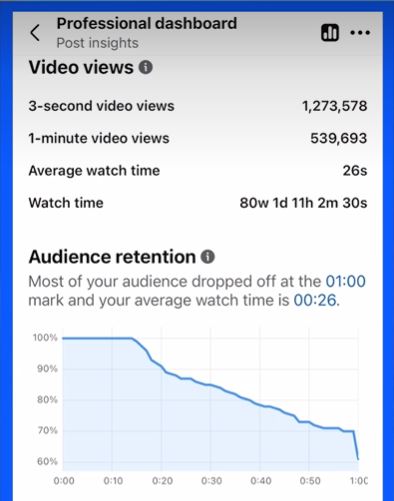 Possibly the most important element of digital marketing for dentists is assessing the performance of marketing activities. Tools such as Google Analytics and Facebook Insights help dentists understand how patients and potential patients engage with the practice’s website and social media posts. This information can be used to prioritize marketing activities that work, and fine-tune those that could perform better.
In addition to providing general data, performance assessments can also help identify which style of marketing activities achieve the highest rates of interaction (proactive, reactive, informative, etc.). By conducting performance assessments periodically, dental practices can adjust their marketing strategies to ensure they are getting the best possible return on investment.
However, when using tools such as Google Analytics and Facebook Insights, it is important to be aware that these technologies do not support HIPAA compliance. Consequently, they must be configured not to collect health, treatment, or payment information that could imply a healthcare relationship with a patient or potential patient. Dentists unaware of this requirement are advised to review HHS guidance on the use of tracking technologies.
Subcontracting Digital Marketing for Dentists
The practical areas of digital marketing for dentists incurs few financial costs and can be done during gaps in practice schedules. However, when a dentist first embarks on a digital marketing program, it can be beneficial to subcontract some digital marketing activities to an agency with experience in healthcare marketing. This will not only jumpstart the digital marketing program, but will help produce measurable results quicker for earlier analysis.
Because dental practices have to be careful about what information they publish, it is advisable to subcontract services to a digital marketing agency with previous experience of digital marketing for dentists. They should also have a knowledge of HIPAA, FDA, and FTC regulations where applicable and be familiar with state privacy and dental board regulations. Dental practices who would like to know more about regulations affecting digital marketing for dentists are advised to review the ADA’s Guide to Marketing and Advertising.




