

Digital Marketing for Plastic Surgeons
The benefits of digital marketing for plastic surgeons – and how these are achieved – can vary depending on the “HIPAA status” of a plastic surgeon, their professional certification, the nature of their services, and state licensing laws. Due to these variables, it may be advisable for a plastic surgeon to subcontract their digital marketing activities to a digital marketing agency familiar with federal and state regulations.
Digital marketing for plastic surgeons has the objective of increasing plastic surgeons’ online presence via a combination of digital resources to attract new customers, and – in the case of cosmetic surgery – to build relationships with existing customers in order to attract repeat business and referrals. However, while digital marketing can be a cost-effective way to increase profitability, federal and state regulations apply to how some digital resources can be used.
What does Digital Marketing for Plastic Surgeons Consist Of?
Digital marketing for plastic surgeons is a multi-layered approach to marketing that utilizes up to five digital resources. The digital resources can be used independently of each other, together, or with other non-digital marketing channels (print, radio, sponsorships, etc.) to create the most appropriate profile for the plastic surgeon’s services. The five digital resources are:
Website Optimization
There are two stages to website optimization. The first is to create keyword-rich and media-rich website content that meets the EEAT criteria (Experience, Expertise, Authoritativeness, and Trustworthiness). If search engines do not think your website content meets the criteria, and is not helpful reliable and “people-first”, they will bury the website in far distant pages of Search Engine Results Pages (SERPs), making it harder for the website to be found organically.

Get The FREE
HIPAA Compliance Checklist
Immediate Delivery of Checklist Link To Your Email Address
Please Enter Correct Email Address
Your Privacy Respected
HIPAA Journal Privacy Policy

The second stage is to write an appealing meta-description for each web page. The meta-description is the snippet of text that appears in SERPs explaining what the page is about. It is effectively the shop window for the web page and, the more appealing the meta-description is, the more likely users will click on the meta-description to see what is inside. The more information provided in the meta-description, the higher the likely Clickthrough Rate.

Google Business Profiles
Google gives businesses the opportunity to claim and personalize a Google Business Profile. Business Profiles appear in SERPs and in Google Maps when a user searches for a type of business or service in a specific location. The Profile provides basic information about what the business does, where it is, when it is open, and how it can be contacted. It also includes directions on how to get to the business by car or public transit from the user’s location.
The Profile can be personalized by plastic surgeons to provide more information about the range of services being offered, how to make an appointment, and whether (for example) insurance is accepted. Plastic surgeons can also add images, videos, and links to website content to expand the amount of information accessible via the Business Profile, while patients can leave reviews on the Profile – either directly, or via a link created by the plastic surgeon.
“Customers are 70% more likely to visit and 50% more likely to consider purchasing from businesses with a complete Business Profile.” Source: Google Support.
Social Media Marketing
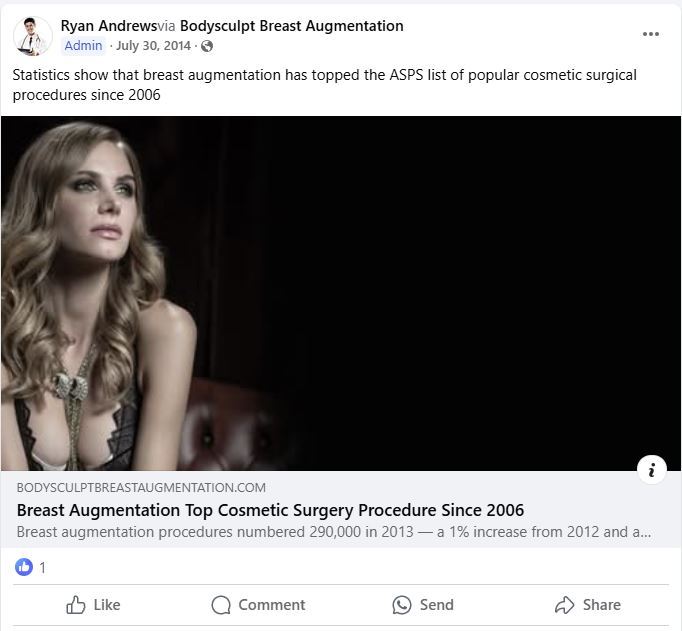
Social media can be a valuable tool for increasing an online presence, but it is important to be conscious of legal and privacy requirements when publishing information on social media platforms or subcontracting social media marketing to commission-based influencers. Due to the risk of violating federal and state regulations, the American Society of Plastic Surgeons (ASPS) has published a range of articles on how to use social media compliantly.
The safest way to use social media in digital marketing for plastic surgeons is for promoting evergreen website content. If social media users click on a link to a blog, image, or video published on the website, this can help increase the Clickthrough Rate for the website – a factor that will not go unnoticed by search engine algorithms that calculate a website’s position in SERPs. Website content is also more easily shared via social media networks.
Managing Online Reviews
Online reviews left by patients can enhance or damage a plastic surgeon’s reputation – and more so a cosmetic surgeon’s reputation. With regards to cosmetic surgery, it has been claimed that 84% of prospective patients read online reviews before choosing a healthcare provider and that 51% of patients read at least six reviews before making a final decision. However, negative reviews have less impact on patient decisions if they have been responded to.
Plastic and cosmetic surgeons that claim a Google Business Profile will likely find most patient reviews in the Profile. However, it is important to be conscious of reviews – both positive and negative – posted to social media sites, consumer comparison sites, and affiliate sites, and to thank patients that have left positive reviews or invite patients who have left negative reviews to get in touch to resolve their issues. (Never discuss individual cases on public forums!).
“45% of patients noted that, when choosing a provider, they are swayed by whether doctors respond to reviews”. Source: Yahoo! Finance
Paid Online Advertising
There are several ways in which it is possible to enhance an online profile via paid advertising. The first is search engine advertising that can elevate an underperforming website to – or near to – the top of SERPs. It is also possible to pay for advertising on social media platforms and on review sites. Social media advertising is a better option for location-based advertising. Review site advertising is a good option if a practice has managed its online reviews well.
Paid online advertising – even when ads are not clicked on – also has the benefit of increasing a plastic surgeon’s or cosmetic surgeon’s brand recognition. This can help support other digital marketing activities inasmuch as when the practice’s name appears in a shared social media post, YouTube video, or online review, the name of the practice will already be familiar to the prospective patient. The familiarity factor can help support retargeting marketing efforts.
“Pay-per-click traffic converts 50% better than organic traffic.” Source: cropink.com
Monitor the Effectiveness of Digital Marketing for Plastic Surgeons
Regardless of what marketing activities a practice adopts, it is important to measure the effectiveness of digital marketing for plastic surgeons to ensure the time and money spent on the activities is generating a worthwhile return on investment. There are numerous tools that can help practices monitor the effectiveness of digital marketing for plastic surgeons – Google Analytics and Facebook Insights being among the most popular because of their ease of use.
However, when monitoring the effectiveness of digital marketing for plastic surgeons, it is important that any technologies collecting, storing, analyzing, and transmitting data are configured not to collect information that could imply a healthcare relationship. Tools such as Google Analytics and Facebook Insights do not support HIPAA compliance, so it is important these analytic tools do not collect information that could be perceived as protected.
Why “HIPAA Status” (Etc.) Matters
The “HIPAA status” of a plastic surgeon, their professional certification, the nature of their services, and state licensing laws matters to digital marketing for plastic surgeons because plastic surgeons that qualify as HIPAA covered entities are required to comply with the HIPAA marketing rules. Many exemptions to the definition of marketing under HIPAA do not apply to plastic surgeons’ activities, which is why this article does not advocate email marketing for plastic surgeons.
A plastic surgeon’s certification and the nature of their services matter because even when a plastic surgeon does not qualify as a HIPAA covered entity, their marketing activities may be governed by ASPS’ ethics advertisers guidelines. The ASPS’ guideline closely align with the Federal Trade Commission’s regulations on “unfair or deceptive acts or practices”, which prohibits uncertified cosmetic surgeons from advertising as a plastic surgeon (although many do).
State licensing laws matter to digital marketing for plastic surgeons because a number of states have passed marketing laws that include “truth in advertising” requirements. These requirements are in addition to any state laws that require affirmative opt-ins from patients in order to receive marketing communications, and state laws that have more stringent privacy protections or patients’ rights than HIPAA. For these reasons, it may be advisable for a plastic surgeon to subcontract their digital marketing activities to a digital marketing agency familiar with federal and state regulations.




