

What Does the Acronym OSHA Stand For?
The acronym OSHA stands for the Occupational Safety and Health Administration – an agency within the Department of Labor that was created in 1971 following the passage of the Occupation Safety and Health Act (referred to as the OSH Act to avoid confusion about what the acronym OSHA stands for). The agency is responsible for:
- Reducing the human and economic cost of workplace accidents.
- Developing workplace safety and health standards in the United States.
- Providing technical and compliance assistance, education, and training.
- Establishing recordkeeping requirements for workplace injuries and illnesses.
- Establishing workplace safety and health rights for employees.
- Enforcing standards through inspections, citations, and/or penalties.
- Working in partnership with states that operate their own safety and health programs.
Prior to the creation of OSHA, the task of workplace safety and health was the responsibility of the Bureau of Labor Standards. However, as the economy expanded during the 1960s, workplace injury rates started to increase. Congress believed a new agency was necessary to tackle the issue and created OSHA with the mission to:
“Assure safe and healthy working conditions for working men and women by setting and enforcing standards and by providing training, outreach, education, and assistance.”
OSHA Coverage – Federal and State
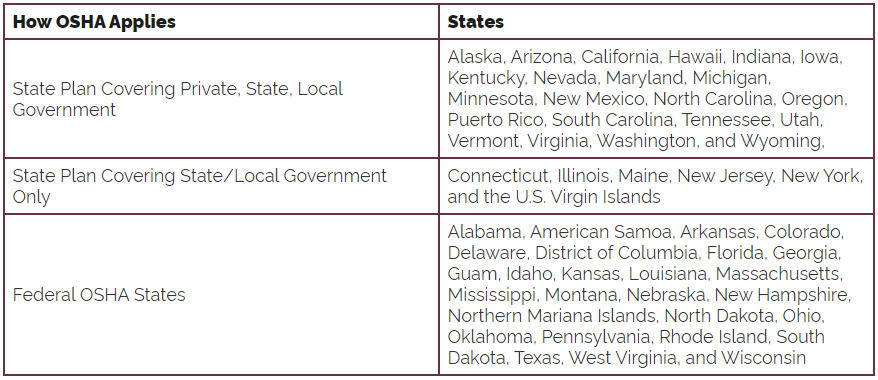
Although a federal law, there are two levels of OSHA coverage – federal and state. Federal OSHA applies in twenty seven states and territories to most private and public employees, and in a further six states and territories to most private employees only as these states and territories have State Plans that govern the workplace safety and health of public employees.

Get The FREE
OSHA & HIPAA Checklist
Immediate Delivery of Checklist Link To Your Email Address
Please Enter Correct Email Address
Your Privacy Respected
HIPAA Journal Privacy Policy
In the remaining states, State Plans apply to all private and public employees that are not excluded from OSHA coverage or whose workplace safety and health is governed by another federal agency with more stringent regulations than OSHA (for example, the mining industry). However, Federal OSHA monitors all State Plans to ensure they are at least as effective as the Federal OSHA program.
How Effective has OSHA Been?
It is difficult to accurately calculate how effective OSHA has been because, at the time the OSH Act was passed, there were fewer standards than there are today and fewer reporting requirements. Additionally, since the OSH Act was passed, the size of the US workforce has more than doubled to over 143 million workers at more than 10 million workplaces.
Nonetheless, in the latest “All About OSHA” leaflet, the agency states that the number of workplace fatalities has decreased from around 14,000 per year in 1970 to 5,190 in 2021 – a reduction of 63%. The rate of reported serious workplace injuries and illnesses has also dropped markedly, from 10.9 per 100 workers in 1972 to 2.7 per 100 workers in 2021.
However, the agency warns against complacency – stating that significant hazards and unsafe conditions still exist in U.S. workplaces. According to the agency’s figures, more than 3.2 million workers suffer a serious workplace injury or illness each year, and millions more are exposed to toxic chemicals that may cause illnesses years from now.
Consequently, in early 2023, OSHA announced it was stepping up its enforcement activities to improve OSHA compliance. Under the new initiative, rather than combining violations into a single citation or penalty, OSHA will apply instance-by-instance citations and penalties for serious violations related to falls, trenching, machine guarding, respiratory protection, permit-required confined spaces, and lockout tagout.
Now, more than ever, employers unsure about their OSHA compliance obligations should seek professional compliance advice.




