

What Information does a Patient Information Form Gather?
What information a patient information form gathers varies depending on the purpose of gathering the information and how it might be used. Because there is no one-size-fits-all patient information form, there is no one-size-fits-all answer to what information does a patient information form gather.
Not only do healthcare organizations develop their own patient information forms, but units within the same healthcare organization can also have different patient information forms depending on what service(s) the unit provides. For example, a pediatrician’s patient information form might ask about a child’s exposure to tobacco smoke rather than how many cigarettes the child smokes per day.
In addition, while some healthcare organizations have a single page patient information form, other healthcare organizations have patient information forms of ten pages or longer. These can include multiple consent and authorization clauses, the HIPAA Notice of Privacy Practices, an advance directive, and/or an agreement to go through a mediation process before filing a lawsuit for medical malpractice.
What Fields Do Patient Information Forms Have in Common?
Most patient information forms start by gathering the same type of information – Name, Date of Birth, Contact Information, Social Security Number, etc. They will likely also ask for the patient’s employment status, health insurance info, and a contact to get in touch with in an emergency. It is also common to see questions relating to a patient’s race, ethnicity and language on a patient information form.
Longer patient intake information forms tend to ask more questions about a patient’s health history, their lifestyle choices, symptoms they are currently experiencing and the medications they are taking for them. Some ask for a brief family medical history, while others may ask about what preventative measures and tests the patient has taken – for example, vaccinations, mammograms, and prostate examinations.
What information does a patient information form gather when the patient is a child can commonly include their birth history, education status, and household information such as whether there are pets in the home. Pediatrician’s patient information forms tend to go much deeper into family histories to identify inclinations towards inherited health conditions or illnesses and potential mental health problems.
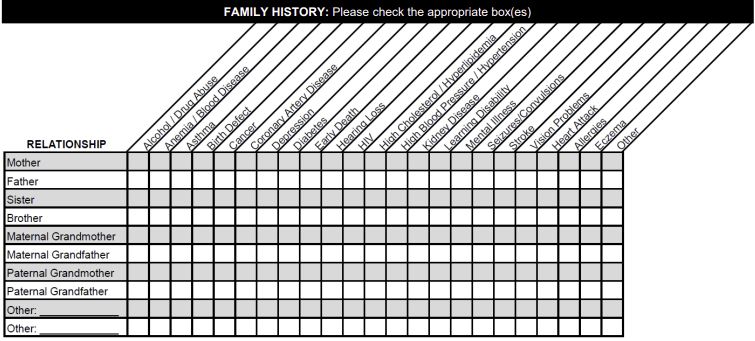
Common Differences in Patient Information Forms
In addition to when patient information forms contain include multiple consent and authorization clauses, differences on patient information forms are most common when the information being gathered is for a particular type of healthcare. For example, Ob/Gyn patient information forms ask very different questions about the patient’s health history than Neurology patient information forms.
The format in which responses are gathered can also differ depending on which data collection standard is being used. Healthcare organizations can – but are not required to – use one of several recognized data collection standards to support interoperable health information exchanges, interoperability between EHRs, and medical research (i.e., USCDI, SNOMED, UMLS, etc.).
Most often, patients will not realize a data collection standard is being used because the information being gathered on paper forms is coded into health data classes and data elements when the information is being manually entered into an EHR, while the process is automated when healthcare organizations use online portals to gather information about new patients.
Why Use Paper Forms When Automated Options Exist?
The reason why many healthcare organizations gather patient information on paper forms is to verify the accuracy of the information being gathered and prevent medical identity fraud. Most often, healthcare organizations ask patients to download a patient information form from their website, complete the form, and bring it with them – with supporting documentation – when they attend a healthcare facility for their first appointment.
This process gives new patients time to assemble the necessary supporting documentation, and gives healthcare organizations a better opportunity to verify the supporting information than if it had been submitted online. What supporting information is necessary will be determined by what information does a patient information form gather – and, as mentioned above, there is no one-size-fits-all answer to this question.




