

Steve Alder


Survey Shows Only a Quarter of Hospitals Have Implemented Secure Text Messaging Platforms
The use of secure text messaging platforms in healthcare has grown over the past few years, although a recent survey published in the Journal of Hospital Medicine suggests the adoption of HIPAA-compliant messaging systems remains relatively low, with only a quarter of hospitals using a secure platform for sending messages to clinicians. The survey was conducted on 620 hospital-based clinicians identified from the Society of Hospital Medicine database. Secure text messaging platforms comply with HIPAA Rules and feature end-to-end encryption to prevent messages from being intercepted. Access controls are also incorporated to ensure only the intended recipient can view messages. Since messages cannot be sent outside the system, the platforms prevent accidental disclosures of PHI. Multi-media messages can also be sent, including test results and images. Secure text messaging platforms are a natural replacement for outdated pagers, allowing much more meaningful communication, although the survey suggests only 26.6% of hospitals have introduced the systems. Even when secure messaging...
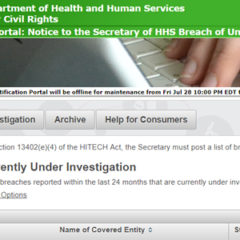
OCR Data Breach Portal Update Highlights Breaches Under Investigation
Last month, the Department of Health and Human Services confirmed it was mulling over updating its data breach portal – commonly referred to as the OCR ‘Wall of Shame’. Section 13402(e)(4) of the HITECH Act requires OCR to maintain a public list of breaches of protected health information that have impacted more than 500 individuals. All 500+ record data breaches reported to OCR since 2009 are listed on the breach portal. The data breach list contacts a wide range of breaches, many of which occurred through no fault of the covered entity and involved no violations of HIPAA Rules. OCR has received some criticism for its breach portal for this very reason, most recently from Rep. Michael Burgess (R-Texas) who said the breach portal was ‘unnecessarily punitive’ in its current form. For example, burglaries will occur even with reasonable physical security in place and even with appropriate controls in place, rogue healthcare employees will access PHI out of curiosity or with malicious intent on occasion, with some considering it unfair for those breaches to remain on public display...

Protected Health Information Stolen in Vision Care Specialists Burglary
The price of medical information on the black market may be high, but it is relatively rare for paper records to be stolen during break-ins. However, a burglary at Vision Care Specialists’ administrative offices in Denver, CO saw paperwork containing the PHI of patients taken by thieves. The burglary was discovered on May 22, 2017 and law enforcement was called in to investigate. An inventory was conducted to determine what items were taken by the thieves and third party forensic investigators were called in to ascertain whether its systems had been accessed. That investigation did not uncover any evidence to suggest electronic medical information had been accessed, although on July 5, Vision Care Specialists discovered that paperwork containing the protected health information of some of its patients had been removed from its offices. The documents contained a range of sensitive information including names, dates of birth, Social Security numbers, medical information, health conditions/diagnoses, financial information and health insurance details. While no reports have been...
Hospital Employee Discovered to Have Accessed Medical Records Without Authorization for 14 Years
Cases of employees snooping on medical records are relatively common, although an incident at Tewksbury Hospital in Massachusetts stands out due to the length of time that an employee was accessing medical records without authorization before being caught. The hospital was tipped off about the employee in April after a former patient made a complaint about their medical record being accessed inappropriately. In response to the complaint, the hospital conducted a full review which revealed the former patient’s medical records had been accessed by an employee without any legitimate reason for doing so. Further investigation revealed it was far from a one off. The employee had been accessing the records of patients without authorization for a period of 14 years. The first instance dated back to 2003 and the inappropriate access continued until May 2017. During that time, the employee accessed the records of more than 1,000 patients. Tewksbury Hospital, which is run by the Department of Public Health, has now written to all patients whose medical records were inappropriately accessed,...
Model HIPAA-Compliant PHI Access Request Form Released by AHIMA
The American Healthcare Information Management Association (AHIMA) has announced it has released a model PHI access request form for healthcare providers to give to patients who want to exercise their right under HIPAA to obtain copies of their health data. The model PHI access request form is compliant with HIPAA regulations and can be easily customized to suit the needs of each healthcare organization. AHIMA claims that until now, a model PHI access request form was not available to healthcare providers. HIPAA-covered entities have had to develop their own forms and there is considerable variation in the forms used by different healthcare organizations. Patients with multiple healthcare providers often find the process of obtaining their health data confusing. AHIMA has listened to feedback from its members and industry stakeholders who explained that the process of accessing medical records was often confusing for patients. Even some healthcare organizations are confused about what is permitted and not permitted under HIPAA Rules when it comes to providing access to health data....

Get The FREE
HIPAA Compliance Checklist
Immediate Delivery of Checklist Link To Your Email Address
Please Enter Correct Email Address
Your Privacy Respected
HIPAA Journal Privacy Policy
Get The FREE
HIPAA Compliance Checklist
Immediate Delivery of Checklist Link To Your Email Address
Please Enter Correct Email Address
Your Privacy Respected
HIPAA Journal Privacy Policy




