

Steve Alder


Benefits of HIPAA for Patients
This is the third article in the ‘Benefits of HIPAA’ series, this time around exploring how the Health Insurance Portability and Accountability Act (HIPAA) and its subsequent amendments have benefited patients. The first article in the series explored how HIPAA has benefited healthcare organizations and the second covered the key benefits of HIPAA for healthcare professionals. A World of Change for Patients It has now been 27 years since HIPAA was signed into law by President Clinton. Memories of what the healthcare industry was like before that time may be starting to fade, but it should not be forgotten just how important HIPAA was at that time and has continued to be for more than a quarter of a century since. The initial Act introduced standards in healthcare to improve efficiency and make sure that healthcare providers, health plans, and healthcare clearinghouses followed standard practices and used the same code sets. No system can function efficiently if the different components do not speak the same language, yet this was essentially how the healthcare system operated at...
Up to 184,000 Clients of Lutheran Social Services of Illinois Impacted by Ransomware Attack
Des Plaines, IL-based Lutheran Social Services of Illinois, one of the largest providers of social services in the state, has announced that its systems were compromised and ransomware was used to encrypt files. The cyberattack was detected on January 27, 2022, and systems were taken offline to contain the attack. and third-party cybersecurity professionals were engaged to investigate the breach and determine the scope of the attack. The forensic investigation and document review concluded on December 28, 2022, and confirmed that the attackers had access to its network between December 31, 2021, and January 27, 2022, and may have viewed or obtained files that contained protected health information. Data theft could not be ruled out, but at the time of issuing notifications, no reports had been received to suggest that sensitive information has been used for identity theft or fraud. The data potentially accessed included names, birth dates, Social Security numbers, financial information, driver’s license numbers, biometric information, diagnosis and treatment information, and health...
Hive Ransomware Operation Disrupted as FBI Seizes the Gang’s Infrastructure
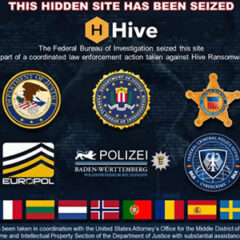
While the Hive ransomware operation was infiltrating servers, exfiltrating data, and demanding ransom payments from their victims, their activities were being observed from within. The FBI has had access to Hive’s ransomware servers since July 2022 and was learning about the group’s methods and has been helping victims recover without paying the ransom. The FBI was biding time until the ideal moment to strike and strike it did. The Department of Justice (DOJ) has announced that the Hive ransomware gang’s digital infrastructure has been seized, including the group’s Tor payment site, data leak site, and the infrastructure used by the group’s leadership and affiliates for communications. The Hive ransomware gang was one of the most active and aggressive ransomware-as-a-service (RaaS) operations, having conducted more than 1,500 attacks on entities in over 80 countries in less than two years. While some ransomware actors have terms and conditions preventing their affiliates from conducting attacks on the healthcare sector, that was not the case with Hive, which has conducted many...
Healthcare Industry Most Commonly Attacked with Downloaders and Ransomware
Blackberry has recently published its Global Threat Intelligence Report, which provides actionable and contextualized intelligence that can be used to improve cyber resilience. The report is based on data collected by Blackberry and threat intelligence provided by third parties, gathered over 90 days between September and November 2022. Throughout the reporting period, downloaders were among the most commonly observed threats. Downloaders are malicious software that often masquerade as legitimate digital documents and executables and are used to download a range of other malicious software. Once installed, these downloaders often remain undetected for long periods and form large botnets of infected devices. The operators of these botnets partner with other threat groups to deliver third-party payloads. One of the most commonly used downloaders is Emotet, which first emerged in 2014 as a banking Trojan. An international law enforcement operation successfully shut down the Emotet botnet in April 2021 but it was eventually rebuilt and started to be used again at the end of 2021. After...
Feds Warn of Malicious Use of RMM Software in Callback Phishing Attacks
Cybercriminals are increasingly using legitimate remote monitoring and management (RMM) software in their attacks, according to a recent joint alert from the Cybersecurity and Infrastructure Security Agency (CISA), the National Security Agency (NSA), and the Multi-State Information Sharing and Analysis Center (MS-ISAC). The campaign was first identified in October 2022 and involves callback phishing. The emails used in this campaign are difficult for email security solutions to identify as malicious as they contain no malicious hyperlinks or attachments. The emails notify the recipient about an impending charge and a phone number is provided in the email for the user to call if they want to avoid the charge being applied. The charges typically relate to a software solution that is coming to the end of a free trial. The user is told that the full price of the software will be charged to the user’s account if no action is taken. Due to the high cost of the software, there is a reasonably high chance that the number will be called. The call is answered and social engineering...

Get The FREE
HIPAA Compliance Checklist
Immediate Delivery of Checklist Link To Your Email Address
Please Enter Correct Email Address
Your Privacy Respected
HIPAA Journal Privacy Policy
Get The FREE
HIPAA Compliance Checklist
Immediate Delivery of Checklist Link To Your Email Address
Please Enter Correct Email Address
Your Privacy Respected
HIPAA Journal Privacy Policy




