

Owen Bates

When does State Privacy Law Supersede HIPAA?
State privacy law supersedes HIPAA when a state law provides greater privacy protections for individually identifiable health information than HIPAA or when a state law provides individuals with more privacy rights than HIPAA. In such cases, the superseding standard or clause applies rather than the whole of the state privacy law. Prior to the passage of HIPAA, there were no nationwide standards to protect the privacy and security of patients’ health information. The confidentiality of medical information was subject to a patchwork of state laws, federal statutes, and professional codes of conduct; and patients’ rights – and the ability to exercise them – often varied depending on where patients lived. This resulted in a situation in which patients had unequal privacy protections. The privacy and security of health information could vary depending on what health conditions were involved and the organizations patients were dealing with. There were also cases in which patients avoided seeking care due to concerns that sensitive health information could be disclosed to employers and...

Cryptocurrencies’ Central Role in Healthcare Ransomware Attacks
One of the benefits of cryptocurrencies is greater financial accessibility for unbanked populations, which includes individuals in remote areas who do not have access to banking infrastructure, but also cybercriminals, who cannot directly put the proceeds from their illegal activities directly through banks, at least not without raising red flags about the source of those funds. Cryptocurrencies have been a godsend for cybercriminals and have played a central role in the massive rise in cybercriminal activity over the past decade, fueling the current ransomware epidemic. The first cryptocurrency, Bitcoin, was invented in 2008 and launched in 2009, and rapidly became a major currency in black market activities, including the first modern dark net market, the Silk Road, which exclusively adopted Bitcoin as payment in 2011. A brief history of ransomware While the earliest form of ransomware, widely thought to be the AIDS Trojan, was first distributed in 1989, the modern ransomware phenomenon started with CryptoLocker, a particularly successful ransomware variant that first appeared in...
What Information does a Patient Information Form Gather?
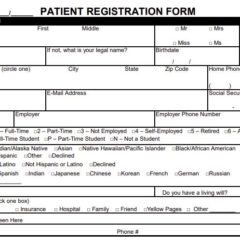
What information a patient information form gathers varies depending on the purpose of gathering the information and how it might be used. Because there is no one-size-fits-all patient information form, there is no one-size-fits-all answer to what information does a patient information form gather. Not only do healthcare organizations develop their own patient information forms, but units within the same healthcare organization can also have different patient information forms depending on what service(s) the unit provides. For example, a pediatrician’s patient information form might ask about a child’s exposure to tobacco smoke rather than how many cigarettes the child smokes per day. In addition, while some healthcare organizations have a single page patient information form, other healthcare organizations have patient information forms of ten pages or longer. These can include multiple consent and authorization clauses, the HIPAA Notice of Privacy Practices, an advance directive, and/or an agreement to go through a mediation process before filing a lawsuit for medical...

What Happens after a HIPAA Complaint is Filed?
What happens after a HIPAA complaint is filed can vary according to who it is filed with, whether or not the complaint is justified, and the nature of the complaint. When you register with a healthcare provider or become a member of a group health plan, you are given a Notice of Privacy Practices. The Notice of Privacy Practices explains how the healthcare provider or health plan can use or disclose your health information and also what rights you have to restrict specific uses and disclosures and request a copy of any health information held about you. The Notice of Privacy Practices should also provide details of who you can complain to if you think a healthcare provider or health plan has used or disclosed your health information impermissibly, or if your rights have been violated. Usually, the contact details are those of the organization´s Privacy Office and the Department of Health & Human Services´ Office for Civil Rights. It is also possible to file a complaint with your State Attorney General. However, the majority of states require that you complain to the...

Is Billing Information is Protected under HIPAA?
Yes, billing information is protected under HIPAA when it relates to an individual and can be linked to their identity, health condition, or healthcare services, because in those circumstances it qualifies as protected health information and must be handled in accordance with HIPAA privacy and security requirements. Billing information often contains more than just financial data. Medical invoices, explanations of benefits, account statements, and payment records frequently include patient names, account numbers, dates of service, provider details, diagnosis codes, procedure codes, and insurance identifiers. When this information can be used to identify a patient and reveals something about their healthcare, it is considered protected health information and is subject to HIPAA safeguards. Even data that appears purely financial can fall under HIPAA if it is associated with healthcare delivery or payment for healthcare services. HIPAA applies to covered entities such as healthcare providers, health plans, and healthcare clearinghouses, as well as business associates that perform...

Get The FREE
HIPAA Compliance Checklist
Immediate Delivery of Checklist Link To Your Email Address
Please Enter Correct Email Address
Your Privacy Respected
HIPAA Journal Privacy Policy
Get The FREE
HIPAA Compliance Checklist
Immediate Delivery of Checklist Link To Your Email Address
Please Enter Correct Email Address
Your Privacy Respected
HIPAA Journal Privacy Policy




