

How to Become OSHA Compliant
The summarized way to become OSHA compliant is to establish which OSHA standards apply to your business, conduct a risk assessment to identify threats to safety and health, and abate identified threats as necessary.
What is OSHA Compliance?
OSHA compliance is complying with all applicable workplace standards promulgated by the federal Occupational Safety and Health Administration or an OSHA-approved state plan to promote safe and healthy workplaces. Most businesses are required to comply with “General Industry” standards, but there are separate standards for the agriculture, maritime, and construction industries.
The OSHA standards for General Industry cover everything from safe working surfaces and workplace ventilation to exposure limits for hazardous substances and chemicals. There are also standards governing hazard communication, injury and illness recordkeeping, and workforce training. The failure to comply with any applicable safety, health, or administrative standard is a violation of OSHA.
What Happens if You Violate OSHA?
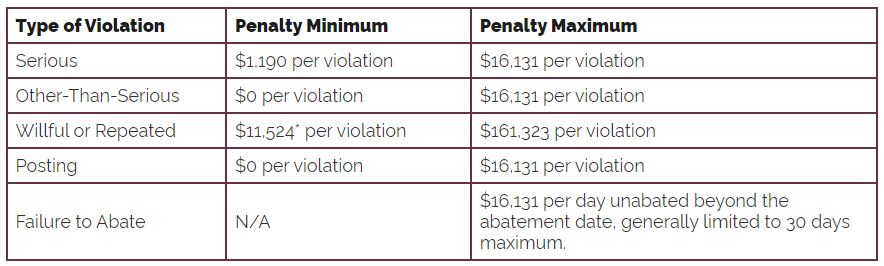
What happens if you violate OSHA depends on the nature of the violation and its outcome. OSHA has a four-tier penalty structure which, at the lowest level, allows inspectors to cite a business for an OSHA violation and give the business time to abate it. If the reason for the violation is not abated in the stated time – or the violation is more serious in nature – OSHA can impose financial penalties.

Get The FREE
OSHA & HIPAA Checklist
Immediate Delivery of Checklist Link To Your Email Address
Please Enter Correct Email Address
Your Privacy Respected
HIPAA Journal Privacy Policy
If a business willfully neglects to mitigate threats to safety and health to an acceptable level – and a member of the workforce suffers a fatal injury as a result – OSHA can refer the case to the Department of Justice to pursue a criminal conviction. If found guilty, negligent employers and safety managers can be fined up to $1 million and sentenced to up to twenty years in jail.
How to Become OSHA Compliant in More Detail
In the introduction, the way to become OSHA compliant was summarized in three stages. While this is an accurate explanation of how to become OSHA compliant, some businesses may require more details. OSHA recommends a seven step process for businesses in the “General Industry” category to become OSHA compliant which consists of:
Identify Standards that Apply to Most Businesses
These include standards relating to safe working surfaces, workplace ventilation, fire safety, exit routes, and hazard communication. Businesses should read these standards, conduct a risk assessment to ensure the standards are being complied with, and implement measures to correct violations and mitigate threats to workforce safety and health.
Identify Standards that Apply to Your Business
For business in the healthcare industry, standards to consider could include the bloodborne pathogens standard, the ionizing radiation standard, and the exposure to formaldehyde standard. It will also be necessary for businesses in the healthcare industry to familiarize themselves with OSHA’s permissible exposure limits for hazardous substances.
Survey the Workplace for Additional Hazards
All organizations have to comply with OSHA’s General Duty clause which requires employers to provide a work environment free from recognized hazards not otherwise covered by an OSHA standard. In the healthcare industry, this clause would cover activities such as safe patient handling, protection from infectious diseases, and preventing workplace violence.
Develop a Workplace Safety and Health Plan
Becoming OSHA compliant is one thing. Remaining OSHA compliant is another. Therefore businesses need to develop a workplace safety and health plan which schedules frequent inspections, includes a process for members of the workforce to report hazards to safety managers , and delegates the responsibilities for documenting and abating reported hazards.
Train Members of the Workforce
Some OSHA standards require members of the workforce to undergo OSHA training before being exposed to a hazard for the first time, while others require initial training AND annual refresher training – for example, the bloodborne pathogens standard. All workforce training should be documented and retained in the event of a subsequent OSHA inspection.
Recordkeeping, Reporting, and Posting
In addition to the documentation of hazard reports and workforce training, businesses are required to keep records of all workplace injuries and illnesses, submit injury and illness data to OSHA annually, report fatalities and severe injuries, and post copies of citations when issued. Note: some State-approved OSHA Plans have more stringent reporting requirements.
Ask for Compliance Assistance when Necessary
The final step in the process to become OSHA compliant is to ask for help if you need it. There are multiple resources on the Help pages of OSHA’s website and third party resources that can help businesses become OSHA compliant. Alternatively, you can call your local OSHA Office to see if your business qualifies for a free onsite consultation.




