

Steve Alder


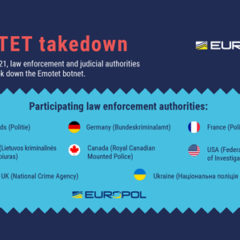
Multinational Law Enforcement Operation Takes Down the Emotet Botnet
Europol has announced the notorious Emotet Botnet has been taken down as part of a multinational law enforcement operation. Law enforcement agencies in Europe, the United States, and Canada took control of the Emotet infrastructure, which is comprised of hundreds of servers around the world. The Emotet botnet was one of the most prolific malware botnets of the last decade and the Emotet Trojan was arguably the most dangerous malware variant to emerge in recent years. The Emotet operators ran one of the most professional and long-lasting cybercrime services and was one of the biggest players in the cybercrime world. Around 30% of all malware attacks involved the Emotet botnet. The Emotet Trojan was first identified in 2014 and was initially a banking Trojan, but the malware evolved into a much more dangerous threat and became the go-to solution for many cybercriminal operations. The Emotet Trojan acted as a backdoor into computer networks and access was sold to other cybercriminal gangs for data theft, malware distribution, and extortion, which is what made the malware so dangerous....
Ransomware Attacks Account for Almost Half of Healthcare Data Breaches
A new report published by Tenable has revealed almost half of all healthcare data breaches are the result of ransomware attacks, and in the majority of cases the attacks were preventable. According to the Tenable Research 2020 Threat Landscape Retrospective Report, 730 data breaches were reported across all industry sectors in the first 10 months of 2020 and more than 22 billion records were exposed. 8 million of those records were exposed in healthcare data breaches. Healthcare registered the highest number of data breaches of any industry sector between January and October 2020, accounting for almost a quarter (24.5%) of all reported data breaches, ahead of technology (15.5%), education (13%), and the government (12.5%). Due to the high number of healthcare data breaches, Tenable researchers analyzed those breaches to identify the main causes and found that ransomware attacks accounted for 46.4% of all reported data breaches, followed by email compromise attacks (24.6%), insider threats (7.3%), app misconfigurations (5.6%) and unsecured databases (5%). Across all industry...
Almost 190,000 Patients Affected by Roper St. Francis Healthcare Phishing Attack
Roper St. Francis Healthcare has notified 189,761 patients that some of their protected health information was contained in employee email accounts that were accessed by an unauthorized individual. The email security breach was detected in late October 2020, and the subsequent investigation revealed three email accounts were compromised between October 14 and October 29, 2020. A review of the email accounts was conducted to determine the information that was potentially accessed. It was not possible to tell if patient information was viewed or exfiltrated, although the attacker would have been able to access names, medical record numbers, patient account numbers, dates of birth, and limited treatment and clinical information, such as dates of service, locations of service, providers’ names, and billing information. The email accounts also contained the health insurance information and Social Security numbers of a limited number of patients. Roper St. Francis Healthcare has offered complimentary credit monitoring and identity theft protection services to individuals whose Social...
Rady Children’s Hospital Facing Class Action Lawsuit over Blackbaud Ransomware Attack
In May 2020, the cloud software company Blackbaud suffered a ransomware attack. As is common in human operated ransomware attacks, data was exfiltrated prior to file encryption. Some of the stolen data included the fundraising databases of its healthcare clients. One of the affected healthcare providers was Rady Children’s Hospital-San Diego, the largest children’s hospital in California in terms of admissions. A class action lawsuit has been proposed that alleges Rady was negligent for failing to protect the sensitive information of 19,788 individuals which was obtained by the hackers through Blackbaud’s donor management software solution. The lawsuit alleges Rady failed to implement adequate security measures and failed to ensure Blackbaud had adequate security measures in place to protect ePHI and ensure it remained private and confidential. The lawsuit alleges individuals affected by the breach now face “imminent, immediate, substantial and continuing increased risk” of identity theft and fraud as a result of the breach and Rady’s negligence. Blackbaud discovered the ransomware...
FBI Issues Warning Following Spike in Vishing Attacks
Many data breaches start with a phishing email, but credential phishing can also occur via other communication channels such as instant messaging platforms or SMS messages. One often overlooked way for credentials to be obtained is phishing over the telephone. These phishing attacks, termed vishing, can give attackers the credentials they need to gain access to email accounts and cloud services and escalate privileges. Recently, the Federal Bureau of Investigation (FBI) issued an alert after a spike in vishing incidents to steal credentials to corporate accounts, including credentials for network access and privilege escalation. The change to remote working in 2020 due to COVID-19 has made it harder for IT teams to monitor access to their networks and privilege escalation, which could allow these attacks to go undetected. The FBI warned that it has observed a change in tactics by threat actors. Rather than only targeting credentials of individuals likely to have elevated privileges, cybercriminals are now trying to obtain all credentials. While the credentials of low-ranking...

Get The FREE
HIPAA Compliance Checklist
Immediate Delivery of Checklist Link To Your Email Address
Please Enter Correct Email Address
Your Privacy Respected
HIPAA Journal Privacy Policy
Get The FREE
HIPAA Compliance Checklist
Immediate Delivery of Checklist Link To Your Email Address
Please Enter Correct Email Address
Your Privacy Respected
HIPAA Journal Privacy Policy




